Construction Toolbox Talks: Complete Management Guide
Make toolbox talks relevant to current work, document attendance and individual sign-off, capture worker questions, assign actions, and verify follow-through.
A toolbox talk is a focused field conversation. It is not a substitute for training required by an applicable standard, proof of competence, or protection against an uncontrolled hazard.
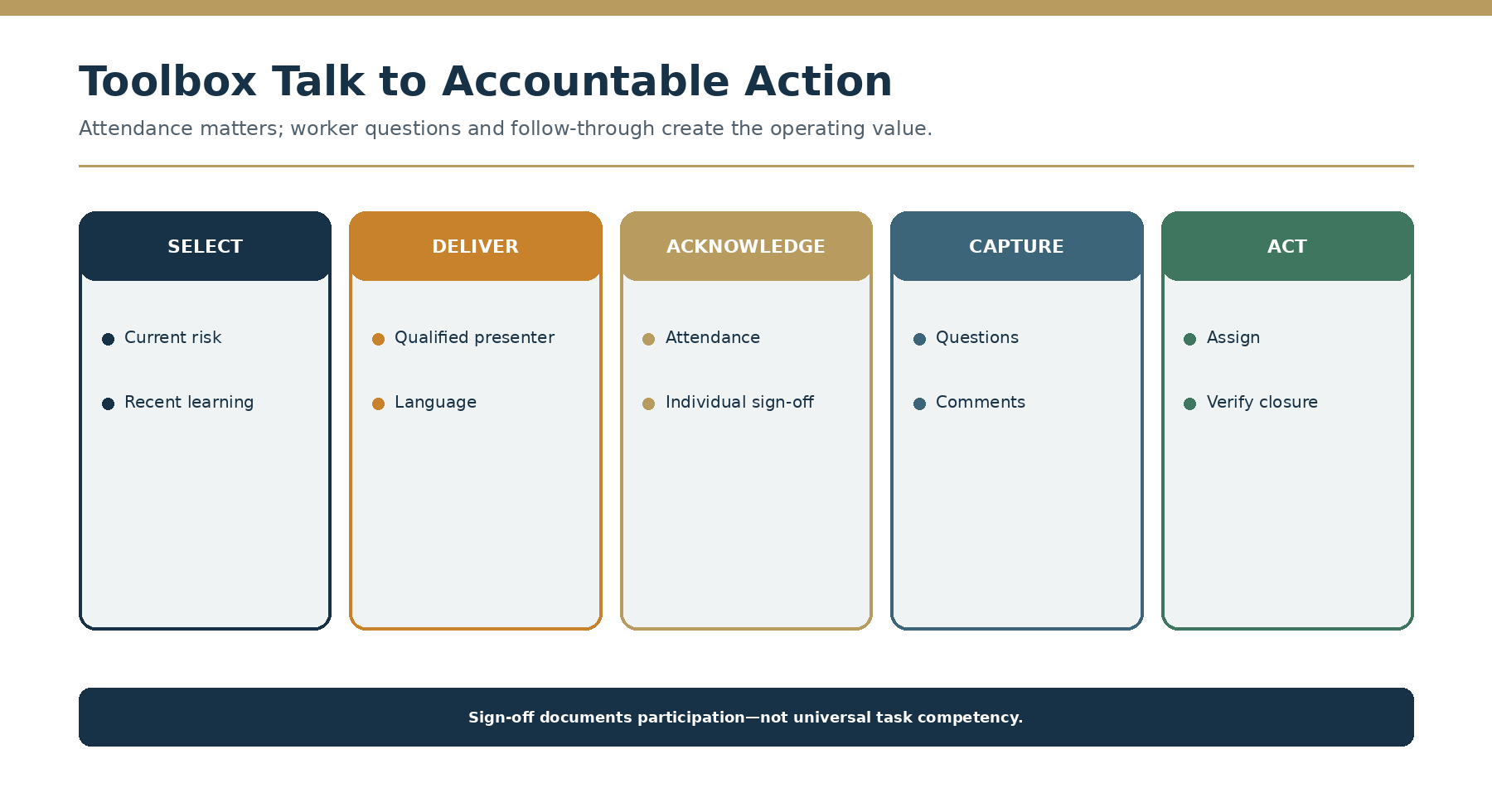
Select topics from current risk
The strongest talks respond to upcoming work, recent observations, repeat inspection findings, near misses, weather, logistics changes, equipment, new workers, or lessons from another project.
Generic weekly repetition turns the meeting into an attendance exercise.
A controlled talk record
Capture:
- topic and reason selected;
- project, location, activity, and crew;
- presenter and qualification;
- date, duration, and language;
- materials used;
- attendees;
- individual acknowledgement;
- questions and comments;
- hazards or concerns raised;
- action items, owners, and deadlines; and
- connection to current work.
Syntecton supports Toolbox Talks with attendance, per-attendee sign-off, comments, and action items.
Sign-off is not competence
A signature establishes that the person was recorded as attending or acknowledging the discussion. It does not establish comprehension, authorization, skill, or qualification for a specific task.
OSHA’s Outreach Training Program offers 10-hour and 30-hour course-completion cards, but those cards do not independently establish competence for every construction activity.
Worker participation
A toolbox talk should make room for questions and conditions the crew sees. Supervisors should not treat worker concerns as interruptions.
Comments and action items should remain linked to the talk and flow into observations, corrective actions, inspections, or planning when appropriate.
Close the actions
If a worker identifies damaged equipment, an unprotected access point, missing training, or a sequencing conflict, documenting the comment is not the outcome. Assign it, set urgency, protect workers, verify correction, and communicate back to the crew.
Program analysis
Review participation by company, project, crew, language, work type, and risk. More talks are not automatically better. Examine whether topics correspond to exposure, whether required people attended, and whether actions closed.
Syntecton’s role
Syntecton moves toolbox talks from signed sheets into the safety operating system. Attendance and individual sign-off remain connected to comments, actions, observations, certifications, incidents, and analytics.
Toolbox-talk quality test
Ask whether the subject was selected because of current exposure, whether the presenter could explain the controls, whether workers could participate in an appropriate language, whether questions were captured, and whether concerns became accountable actions.
Common failure modes
- Reusing a generic topic unrelated to planned work
- Treating a signature as proof of comprehension
- Allowing one person to sign for the crew
- Recording worker concerns without assigning follow-up
- Using a toolbox talk instead of required formal training
- Measuring only the number of talks delivered
A ten-minute conversation that changes tomorrow’s lift plan can be more valuable than an hour-long generic presentation with perfect attendance.