OSHA Recordkeeping for Construction: 300, 300A, 301
Understand construction OSHA recordkeeping: Forms 300, 300A and 301, recordability, restricted-duty and lost-time classifications, TRIR, DART, and reporting.
OSHA recordkeeping is not the same as incident management, severe-event reporting, workers’ compensation, insurance reporting, or owner notification. One event may affect all of them, but each has different rules and purposes.
Many—but not all—employers must maintain OSHA injury and illness records. Coverage, exemptions, establishment structure, State Plan requirements, electronic submission, posting, privacy, and retention require current review.
The three core forms
- OSHA Form 301: Provides incident-level information or permits an equivalent form containing the required information.
- OSHA Form 300: Logs recordable work-related injuries and illnesses and their classification.
- OSHA Form 300A: Summarizes the establishment’s annual recordkeeping data.
Syntecton supports Forms 300, 300A, and 301 and audit-ready OSHA PDF exports.
Classification workflow
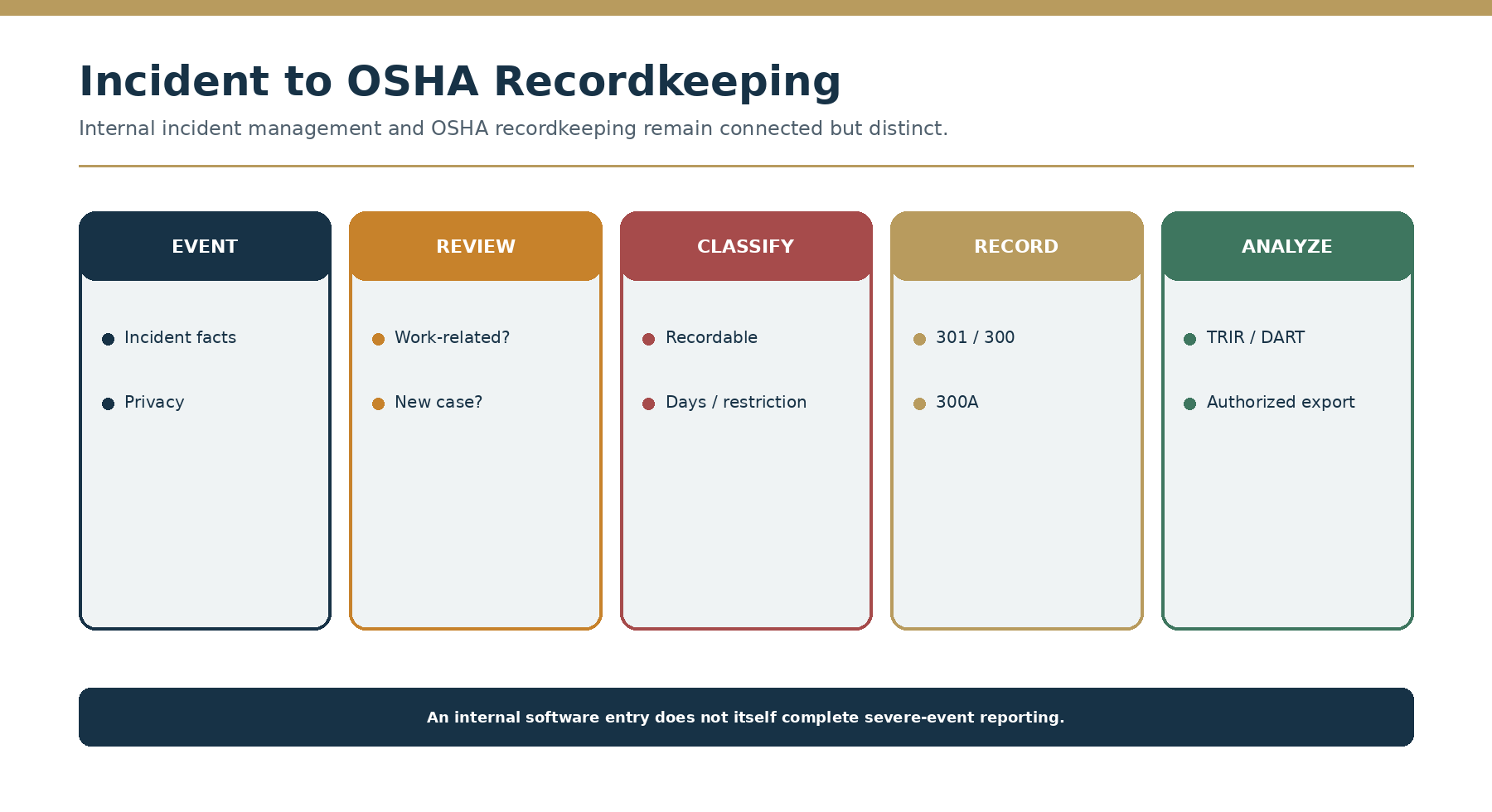
The decision normally requires factual and authorized review of:
- whether an injury or illness occurred;
- whether it is work-related;
- whether it is a new case;
- whether it meets general or specific recording criteria;
- days away from work;
- job restriction or transfer;
- medical treatment beyond first aid;
- loss of consciousness;
- significant diagnosed conditions; and
- privacy-case requirements.
Software can organize questions and calculate consequences. It should not allow unqualified users or a model to make final classifications without review.
Syntecton supports recordable, restricted-duty, and lost-time classifications.
Severe-event reporting is separate
OSHA states that work-related fatalities generally must be reported within eight hours, and covered inpatient hospitalizations, amputations, and losses of an eye within 24 hours, subject to detailed timing, scope, and exception provisions.
An OSHA 300 entry or internal incident notification does not complete that external reporting obligation. State Plan reporting routes can differ.
TRIR and DART
TRIR and DART are lagging rates based on case classifications and hours worked. Syntecton computes these measures, but calculation accuracy depends on complete hours, correct establishment scope, consistent period, and valid case classification.
The rates help compare periods and identify outcome trends. They do not show whether one open imminent hazard exists, whether reporting is suppressed, or whether corrective actions are effective.
Access and privacy
Incident medical details and privacy-case information should be restricted. Project participants may require action or trend information without access to protected personal data.
The audit record should show who classified the case, what facts supported the decision, when days-away or restricted-duty values changed, and who certified or exported required records.
Syntecton’s role
Syntecton connects incident investigation, OSHA forms, case classifications, restricted-duty and lost-time data, calculated TRIR and DART, analytics, permissions, and PDF exports.
The correct promise is controlled recordkeeping—not guaranteed OSHA compliance.
Recordkeeping control checklist
- Define the establishment and reporting period.
- Restrict who may make or change classification decisions.
- Preserve the facts and reviewer supporting each decision.
- Track days away, restriction, and job transfer as facts evolve.
- protect privacy-case and medical information;
- reconcile annual hours and average employment;
- document Form 300A review and certification responsibilities;
- identify posting and electronic-submission obligations separately; and
- preserve corrections and prior values in the audit history.
Critical distinction
Recordable does not mean reportable to OSHA within eight or 24 hours, and a severe reportable event may require action before the complete recordability analysis is finished. The platform should therefore maintain separate clocks, decisions, responsible roles, and evidence.
Similarly, workers’ compensation acceptance or denial does not automatically determine OSHA recordability. Each process applies its own governing criteria.