Construction Incident and Near-Miss Management Guide
Manage construction incidents and near misses from emergency response through investigation, corrective action, learning, and documented closeout.
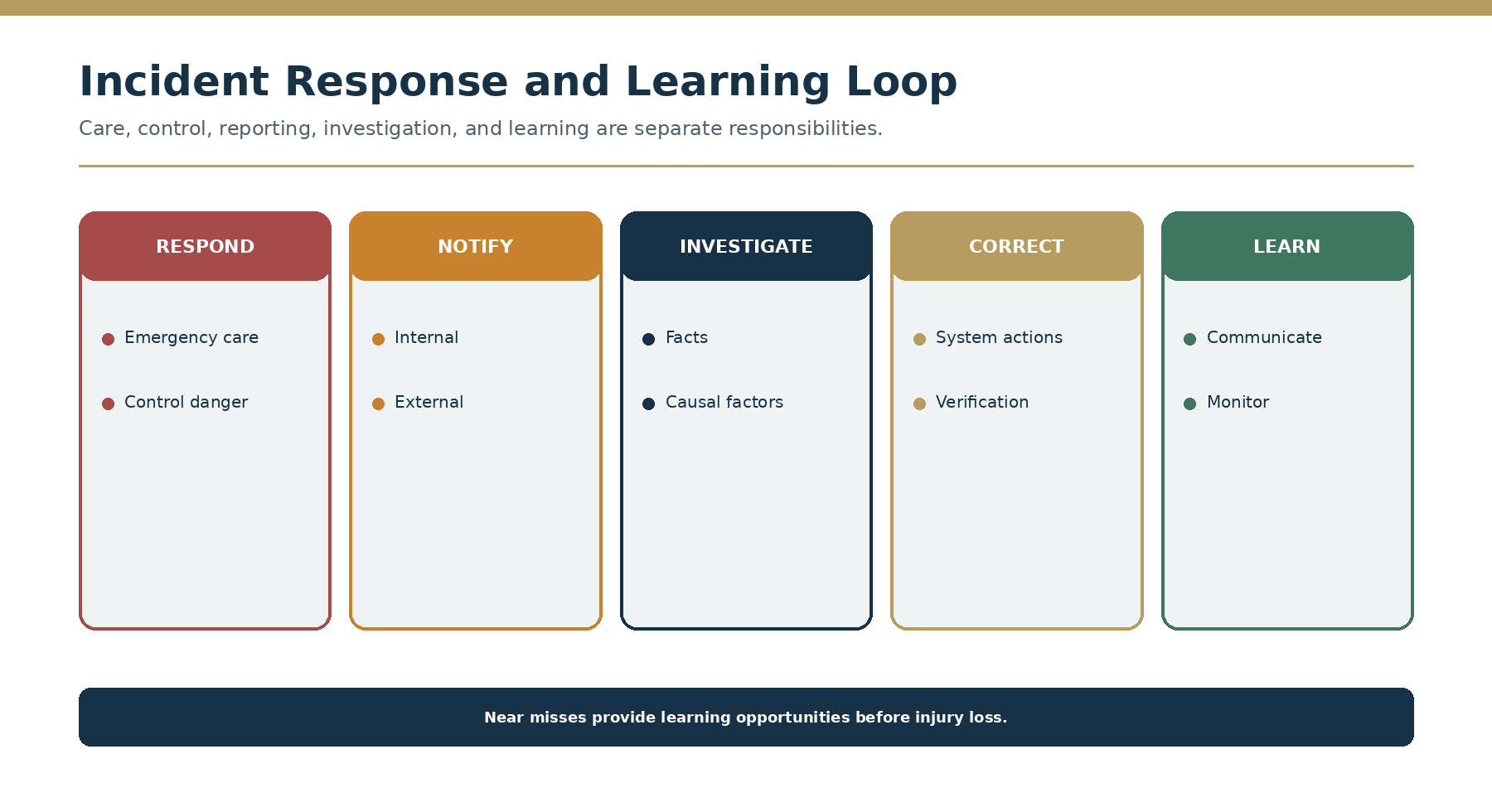
Incident management begins with care and control—not paperwork. The first priorities are emergency response, protection from continuing danger, and required notification. Investigation follows only when people and the scene are appropriately protected.
Keep event types distinct
- Observation: A condition or behavior with potential for harm.
- Near miss: An unplanned event causing no injury or damage but having credible potential.
- First-aid case: Treatment within the applicable recordkeeping definition.
- Recordable case: A work-related injury or illness meeting applicable OSHA recording criteria.
- Severe reportable event: A fatality or specified severe outcome triggering separate OSHA reporting requirements.
- Property or environmental event: An event with separate contractual, insurance, regulatory, or internal processes.
One event may trigger several workflows. Their criteria, recipients, deadlines, confidentiality, and authority are different.
Immediate response
- provide emergency care;
- eliminate or isolate continuing danger;
- activate emergency response;
- preserve the scene where appropriate;
- notify required internal and external parties;
- determine recordkeeping and reporting obligations;
- collect facts and evidence;
- investigate causal factors;
- implement corrective actions;
- communicate lessons appropriately; and
- verify effectiveness.
Recording the event in Syntecton does not itself satisfy external OSHA reporting.
Investigate beyond blame
Evidence may include photographs, witness accounts, plans, pre-task records, inspections, training, certifications, equipment records, weather, schedule conditions, communications, medical facts with restricted access, and prior similar events.
Evaluate planning, sequencing, supervision, comprehension, equipment, design, workload, language, fatigue, environment, subcontractor coordination, availability of controls, earlier warnings, and management response.
“Employee error” may describe the final action but rarely explains why the system allowed the exposure.
Near misses are operating intelligence
Near misses provide learning without injury loss. Reporting should be easy, protected, acknowledged, and followed by visible action.
High near-miss volume is not automatically bad performance. It may indicate trust and awareness. The quality of investigation and corrective follow-through matters more than suppressing the count.
Confidentiality
Medical information, privacy cases, legal analysis, workers’ compensation materials, and sensitive witness records require role-based access. The general project team may need to know the lesson and control without seeing protected details.
Closeout
An incident should close only after investigation is complete, required classifications and reports are addressed, corrective actions are verified, lessons are communicated, and any follow-up monitoring is assigned.
Syntecton supports incidents and near misses through investigation and documented closeout, with incident PDF exports for a coherent audit record.
Investigation questions
- What work was planned and what work actually occurred?
- Which controls were expected?
- Were they present, practical, understood, and maintained?
- What changed in logistics, sequencing, staffing, equipment, or environment?
- Were similar conditions previously reported?
- Did production pressure or incentives influence behavior?
- Which system action can prevent recurrence?
Closeout quality
Avoid closing an event merely because the investigation report is signed. Confirm that corrective actions were implemented, high-risk controls were independently verified, affected teams received usable lessons, OSHA or other reporting decisions were documented, and follow-up monitoring has an owner.
Near-miss closeout deserves the same discipline proportionate to potential severity. The absence of injury should not erase the underlying exposure.