Construction Safety Inspections and Corrective Action Management
Design construction safety inspections that identify hazards, assign severity-based corrective actions, verify closure, and expose repeat risk.
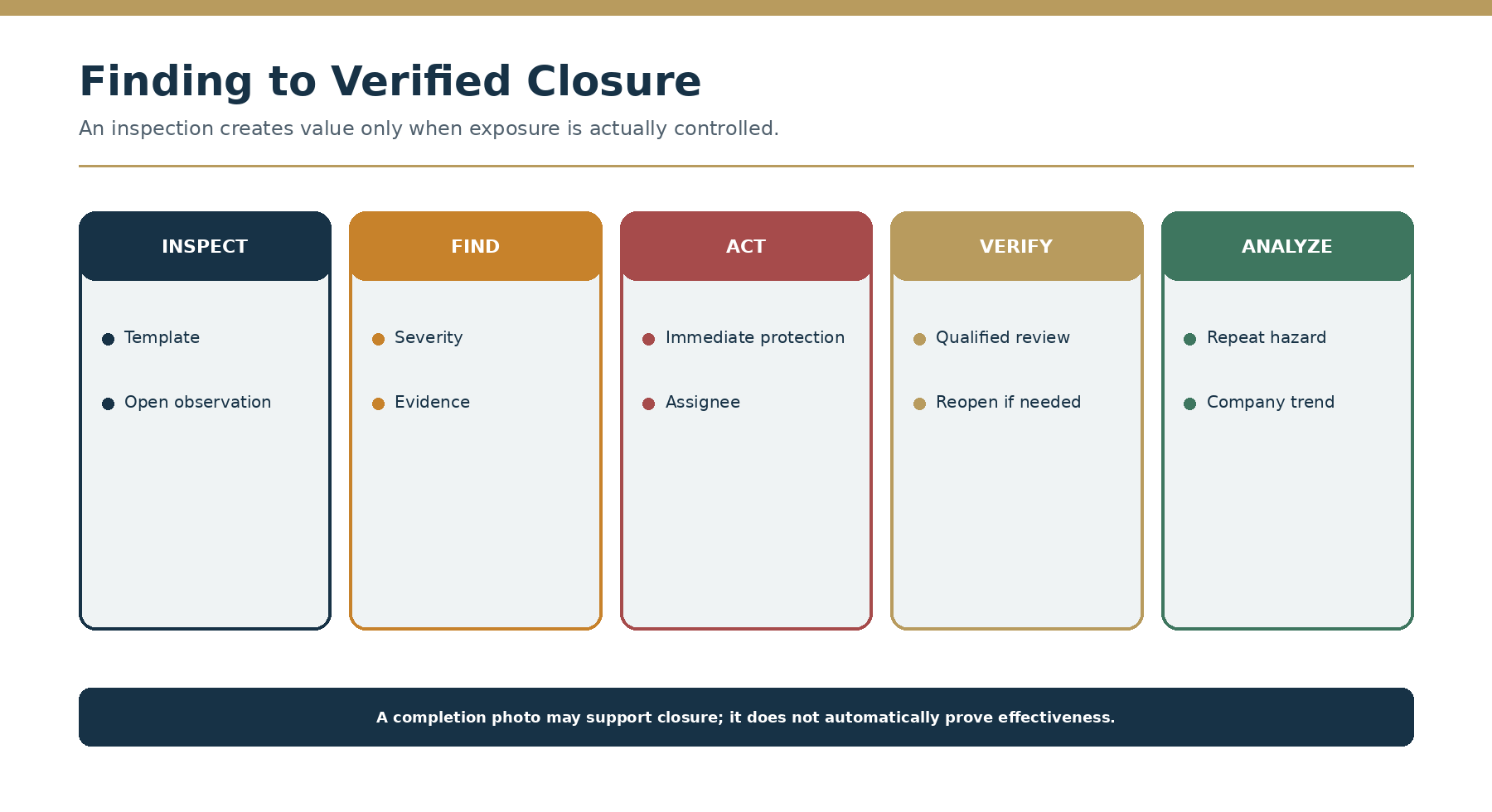
A safety inspection is not complete when the checklist is submitted. It is complete when identified exposure is protected, assigned, corrected, independently verified where appropriate, and monitored for recurrence.
Inspection types
Projects may use daily superintendent walks, competent-person inspections, weekly project inspections, corporate audits, equipment checks, excavation and scaffold inspections, pre-use checklists, owner reviews, focused high-hazard inspections, and post-event inspections.
One checklist cannot serve every phase, activity, jurisdiction, employer, and site condition. Templates should guide observation while allowing inspectors to record hazards not anticipated by the form.
Syntecton supports reusable Safety Inspection checklist templates and structured findings.
The inspection record
A credible record captures inspector, qualification, date, time, location, project, employer, affected trade, checklist version, compliant conditions, findings, severity, photographs, annotations, immediate protection, responsible party, assignee, due date, verification, closure, and repeat-finding status.
Inspection volume alone is a weak metric. A company can perform more inspections while high-risk findings age faster.
Severity changes workflow
- Critical or imminent: Protect workers, stop affected work where appropriate, and notify leadership immediately.
- High: Apply immediate interim control and complete rapid permanent correction.
- Medium: Assign correction within a defined short period.
- Low: Correct through normal workflow and monitor.
Thresholds should be company-defined and aligned with applicable requirements. They are not universal OSHA categories.
Corrective-action lifecycle
The state model should distinguish identified, immediate protection, assigned, in progress, ready for verification, closed, reopened, and escalated.
The assigned contractor may report that correction is complete. That does not mean the system should automatically treat a critical finding as verified. High-risk closure may require a qualified independent verifier.
What verification proves
Verification should document what was corrected, completion time, evidence, verifier, verification time, control type, residual risk, and follow-up requirements.
A photo can support closure, but a photo alone may not show that the control is appropriate, stable, understood, and effective under operating conditions.
Recurrence and systemic response
Repeat findings should connect across locations, trades, projects, checklist questions, activities, and prior corrective actions. Repetition may call for a design change, equipment purchase, subcontractor intervention, training revision, planning requirement, or executive decision.
Executive reporting
Leaders should see critical and high findings open, aging by severity, average and median closure time, repeat findings, reopened findings, employer outliers, inspection coverage, and corrective actions owed by management.
Do not compress the entire program into one score. A 95% compliance rate can hide one unresolved imminent hazard.
Syntecton’s role
Syntecton supports inspection templates, findings, corrective actions, responsibility, closeout, observations, company-wide rollup, Analytics Hub reporting, and audit-ready inspection or observation PDFs.
The software’s job is to prevent the finding from disappearing between identification and verified closure.
Inspection quality test
An effective inspection program should answer:
- Did coverage match the actual high-risk work?
- Were findings described precisely enough to act?
- Was immediate protection documented?
- Did severity produce the required escalation?
- Were responsible employers and individual assignees identified?
- Was closure verified by an appropriate person?
- Did the same condition recur?
Example
An inspector finds a missing guardrail at a material-delivery opening. The weak workflow records a photograph, assigns “install guardrail,” and closes when another photograph is uploaded. The stronger workflow protects the opening immediately, identifies why the guardrail was removed, verifies the engineered or approved access arrangement, assigns responsibility for future deliveries, confirms the correction in operating conditions, and flags recurrence if the same logistics conflict appears elsewhere.
That distinction separates checklist completion from risk control.