Construction Hazard Identification and the Hierarchy of Controls
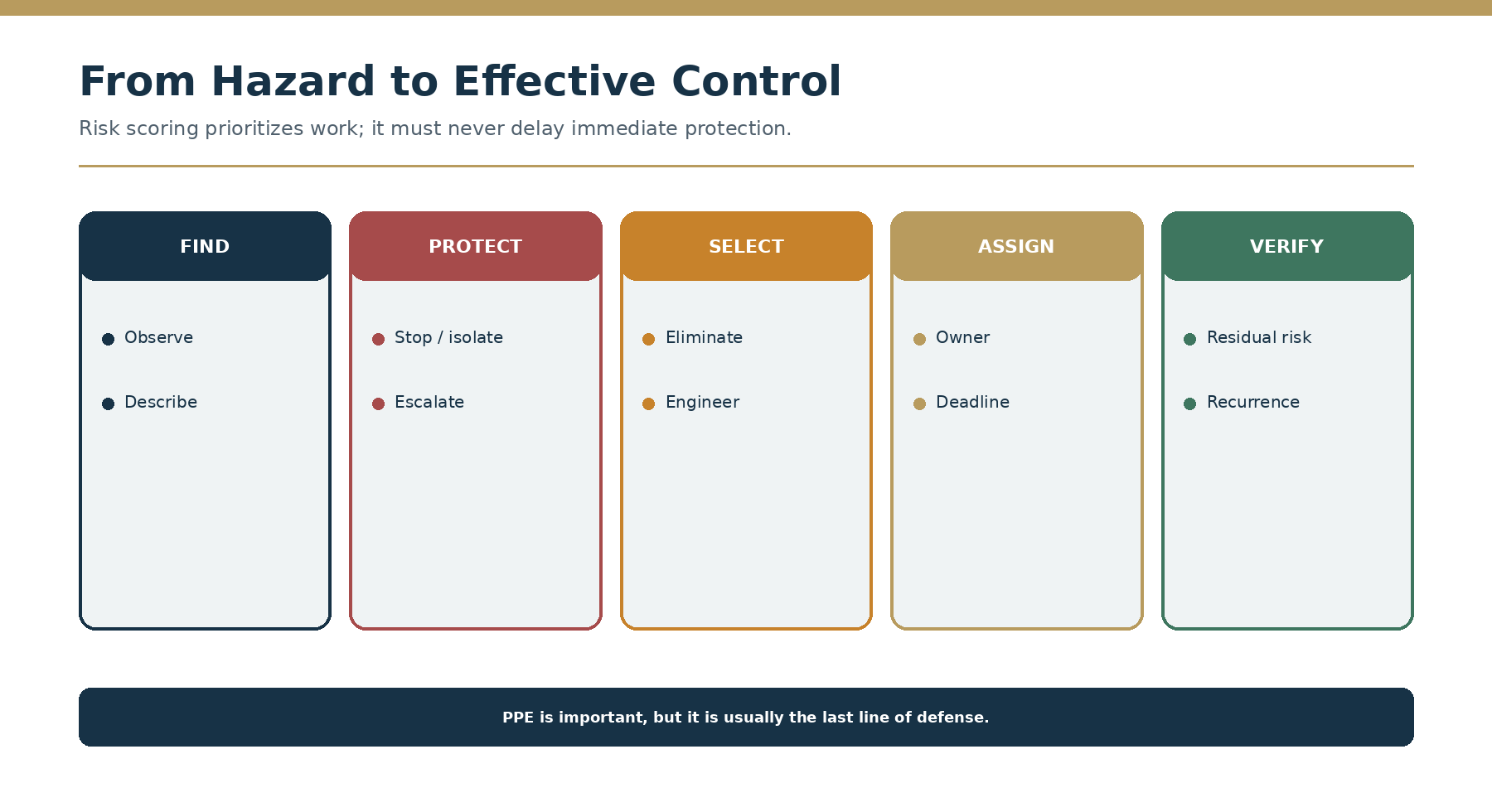
Identify construction hazards before exposure, assess changing conditions, select controls using the hierarchy of controls, and verify effectiveness.
Most serious safety failures do not begin with an injury. They begin when a hazard is missed, normalized, accepted temporarily, or “closed” without an effective control.
Hazard identification must operate before mobilization, before each phase, before each task, and whenever conditions change.
Where hazards emerge
Use design documents, specifications, logistics plans, existing-condition surveys, preconstruction review, job hazard analyses, pre-task plans, competent-person inspections, worker observations, equipment instructions, Safety Data Sheets, incident history, weather, environmental exposure, simultaneous operations, public interface, and schedule revisions.
Construction changes continuously. Yesterday’s plan may be unsafe after access, sequencing, crew size, equipment, adjacent work, or weather changes.
Physical and health hazards
The OSHA Construction Focus Four—falls, struck-by, electrocution, and caught-in or between hazards—deserve sustained attention. A complete commercial-construction program also considers excavation, cranes and rigging, scaffolds, confined spaces, fire, housekeeping, material handling, silica, asbestos, lead, noise, heat, ergonomics, respiratory exposure, and site-specific hazards.
Health hazards may be less visible than unprotected edges or moving equipment. Their control often requires exposure assessment, engineering, work practices, respiratory protection, or medical surveillance under applicable requirements.
Assess risk without delaying control
Severity, likelihood, exposure count, frequency, and control reliability can help prioritize work. A matrix is a management tool—not permission to leave an imminent or recognized serious hazard open while someone calculates a score.
Critical conditions require immediate protection, work stoppage where appropriate, and escalation.
Apply the hierarchy of controls
The preferred control order is:
- eliminate the hazard;
- substitute a safer method or material;
- apply engineering controls;
- apply administrative or work-practice controls; and
- use PPE.
For an unprotected edge, a reminder to “be careful” is weak. Guardrails, engineered fall-protection systems, controlled access, appropriate training, and verification address the exposure more directly.
For silica, issuing a dust mask without exposure analysis, engineering controls, and the applicable respiratory program may be inadequate.
Observations as the early-warning layer
An observation should capture hazard, location, activity, employer, people exposed, severity, evidence, immediate protection, recommended control, assigned owner, deadline, and reporter follow-up.
Positive observations also matter. They show controls functioning and help repeat effective planning—not merely count unsafe acts.
Syntecton supports observations as their own records, allowing early signals to remain distinct from inspections and incidents.
Correct the system, not only the person
“Worker failed to follow procedure” is rarely a complete explanation. Examine planning, sequencing, supervision, training comprehension, equipment, design, production pressure, language, fatigue, coordination, practicality of controls, prior similar findings, and management response.
Human choices matter, but stopping at the last person prevents organizational learning.
Verify control effectiveness
Closure should establish whether the hazard was eliminated, substituted, engineered, administratively controlled, or left dependent on PPE. Document residual risk and monitoring.
Repeat observations may indicate that the selected control is impractical, supervision is inconsistent, or the organization is repeatedly treating symptoms.
Syntecton’s role
Syntecton connects observations, inspection findings, photographs, responsible companies, corrective actions, verification, incidents, and analytics. That lets leaders see not only how many hazards were found, but whether the same hazard is returning across projects.
Common failure modes
- Copying yesterday’s plan. Repetition without re-evaluating location, crew, sequencing, weather, equipment, and adjacent operations creates false evidence.
- Treating every finding as worker behavior. This misses design, logistics, planning, supervision, equipment, and production-pressure causes.
- Using one checklist as the hazard universe. Checklists guide observation; they must allow hazards outside the template.
- Closing on administrative action. Training or a reminder may be appropriate, but it should not substitute for elimination or engineering where stronger control is feasible and required.
Practical field test
Before work begins, ask: What can release energy, fall, move, collapse, strike, expose, ignite, engulf, or obstruct rescue? Who enters the exposure zone? What prevents contact? Who verifies the control? What condition would require work to stop?
Those questions convert a generic risk assessment into an operating decision.