Construction Record Retention and Legal Holds
Develop construction record-retention and legal-hold controls for project records, custodians, deletion suspension, preservation, export, review, and release.
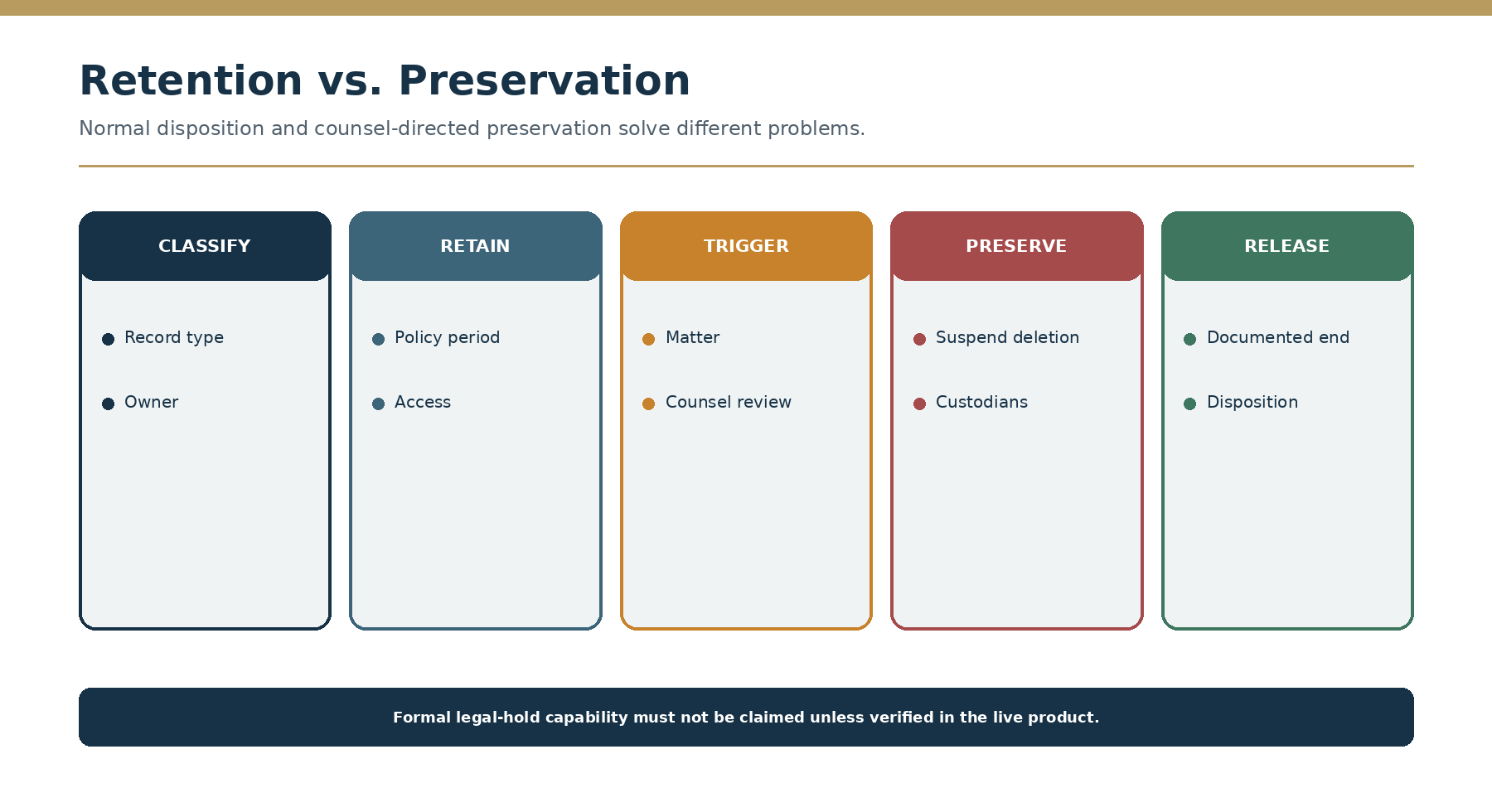
Retention and preservation solve different problems.
Normal retention keeps records for defined business, contractual, statutory, regulatory, insurance, tax, or operational periods and disposes of them through governed policy. A legal hold suspends ordinary deletion for information potentially relevant to a matter when authorized counsel determines preservation is required.
Keeping everything forever is not a mature strategy. Deleting information through routine automation after preservation becomes necessary is also risky.
Important: This guide is operational education, not legal advice. Retention schedules and legal holds are established with qualified counsel, and a legal hold is placed and released by authorized legal personnel—not by software. Obligations depend on contract, jurisdiction, and the specific facts.
Record classification
Classify contracts, modifications, drawings, RFIs, submittals, daily reports, safety records, personnel or medical information, payment records, warranties, closeout, correspondence, and system history. Different obligations may apply.
Counsel, accounting, insurance, safety, human resources, and records professionals may need to contribute.
Legal-hold workflow
A mature process may include:
- matter and custodian identification;
- counsel authorization;
- record and system scope;
- preservation start;
- suspension of relevant deletion;
- custodian acknowledgement;
- collection status;
- access restriction;
- periodic review;
- release authority; and
- documented disposition after release.
Federal Rule of Civil Procedure 37(e), in federal civil litigation, addresses loss of electronically stored information that should have been preserved in anticipation or conduct of litigation when reasonable steps were not taken and the information cannot be restored or replaced. State law, arbitration, contract, and regulatory duties may differ.
Recoverable deletion
Ordinary users should not be able to permanently erase governed records immediately. Recoverable deletion, retention windows, administrator controls, audit history, and backup procedures can reduce accidental loss.
Deletion while a hold applies should require control outside normal project administration.
Export and accessibility
Preserved information must remain readable and understandable. Export should maintain filenames, record identifiers, versions, metadata, relationships, attachments, timestamps, and audit context where supported.
Federal Rule of Civil Procedure 34 includes production requirements for documents and electronically stored information in its federal context. A proprietary export that strips relationships or requires a discontinued application may create practical problems.
Syntecton capability boundary
Syntecton can be positioned around structured project records, permissions, audit history, export, and recoverable workflows only where verified.
Record retention and legal holds sit within a company’s broader construction legal risk management program.
Retention and preservation stress test
Identify record classes, owners, governing periods, archived-project treatment, recoverable deletion, administrator override, backup alignment, and export format. Then place a hypothetical counsel-authorized hold while ordinary deletion is scheduled.
Confirm whether relevant records, attachments, messages, versions, audit history, and integration data remain preserved across projects and departed-user accounts. Test an administrator’s deletion attempt and document the release process.
If the platform cannot perform these controls, the gap belongs in the company’s preservation plan.