Construction Legal Document Management Software
Evaluate construction software for controlled versions, permissions, approvals, notices, signatures, linked records, audit history, and legal-risk signals.
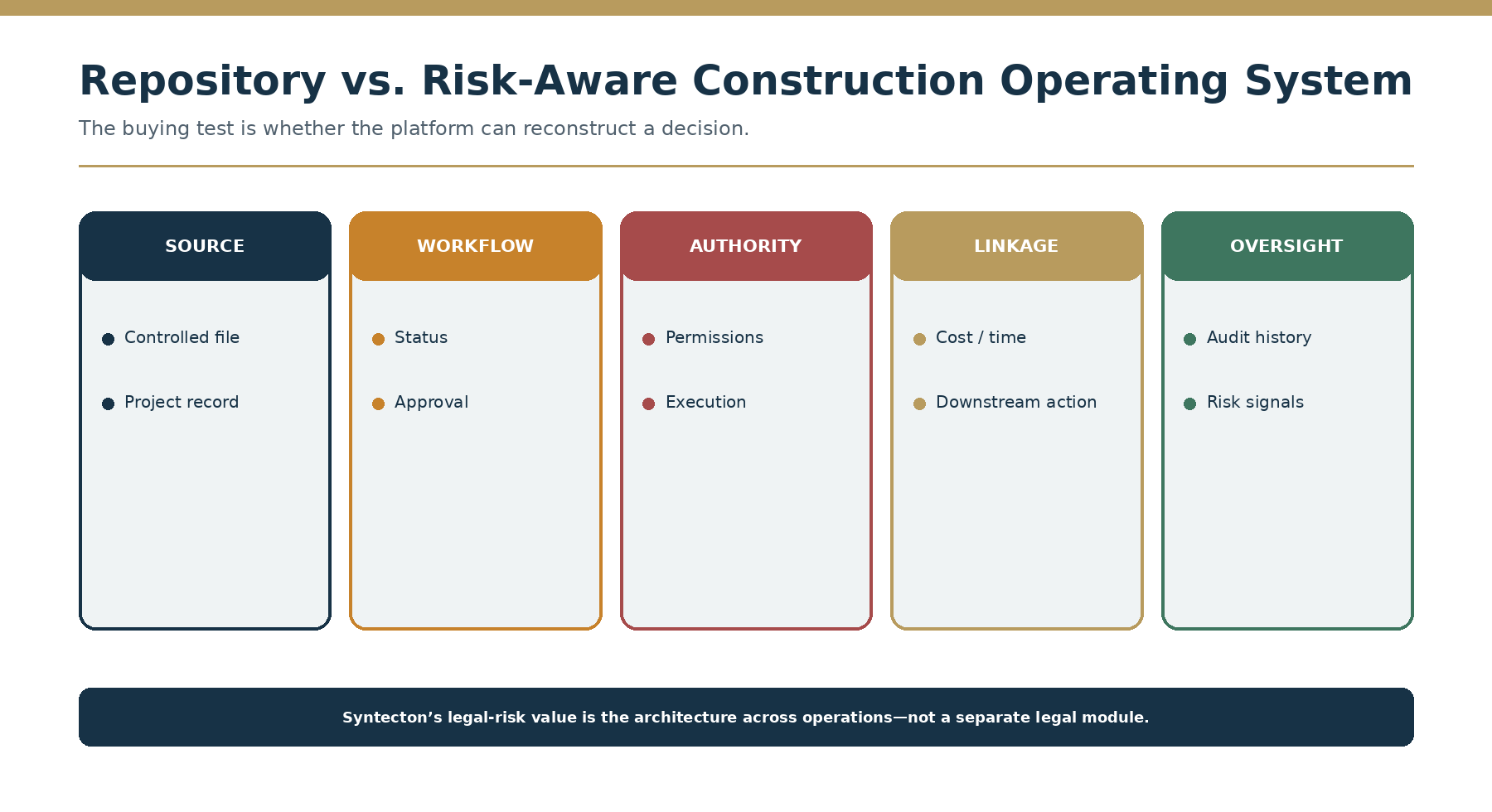
A document repository answers where a file is stored. Legal-risk-aware construction software should also explain the file’s status, authority, relationships, distribution, approvals, history, and downstream consequences.
The buying test is not whether the platform has folders. It is whether the project can reconstruct a decision.
Contract configuration
Can the company configure notice types, recipients, deadlines, change authority, approval steps, payment requirements, document status, and project-specific roles? Defaults should not be presented as universal contract compliance.
Controlled documents
Evaluate revision history, publication authority, issue purpose, current status, supersession, distribution, acknowledgement, linked RFIs and submittals, field access, and preserved prior versions.
Permissions
Test view, create, edit, submit, respond, approve, execute, publish, supersede, reopen, export, and delete independently across owners, contractors, subcontractors, designers, inspectors, clients, and administrators.
Approval and execution
Verify exact document version, authority, rejection and revision history, required evidence, signature status, effective date, and downstream contract or financial effect.
Auditability
Ask whether the history shows actor, organization, acting role, prior and new values, exact version, timestamp, notification, permission change, export, restoration, and integration result.
Do not accept “immutable” or “court-ready” without technical and legal substantiation.
Confidentiality
The platform should restrict legal advice, claims strategy, settlement material, medical information, personnel matters, bid confidentiality, security information, and proprietary data by matter and named access where needed.
Software permissions support confidentiality. They do not independently create legal privilege.
Risk signals
Useful operational signals include:
- notice deadline approaching;
- cost or time event without a notice decision;
- work proceeding without written authority;
- approval outside configured limit;
- superseded drawing accessed after replacement;
- official metadata changed after publication;
- approved change missing from billing;
- invoice exceeding commitment;
- failed signature;
- unusual permission escalation;
- incomplete downstream update; and
- export or deletion activity requiring review.
Signals route conditions for review. They should not declare legal liability.
AI’s proper role
AI can extract obligations, summarize chronology, find missing support, compare versions, identify contradictions, and draft notices from approved project context.
AI should not provide unsupervised legal advice, decide privilege, establish entitlement, place or release a legal hold, or send contractual notices without authorized review.
Syntecton as a risk-aware Construction Operating System
Syntecton’s strategic differentiation is that legal-risk control is distributed across the platform: permissions, workflows, notifications, signatures, project records, financial controls, safety processes, and audit history.
The message is not “claims-proof construction.” It is:
Syntecton helps preserve the ordinary project record as a coherent system of operational evidence.
Procurement demonstration
Ask the vendor to take one event from field record through controlling revision, configured notice, authorized RFI response, cost and schedule exposure, change approval, exact-document execution, downstream contract and billing update, restricted access, and final export.
If the demonstration consists of searching folders and viewing an activity feed, the product has shown document storage—not risk-aware operations.
Procurement red flags include:
- universal approval rights;
- indistinguishable superseded files;
- approval surviving material revision;
- audit history without prior values;
- automatic “legal notice” claims;
- folder labels presented as privilege;
- exports stripped of relationships;
- AI presented as legal authority; and
- guarantees of admissibility or claim prevention.