Construction Change Order Documentation and Notice Requirements
Build a defensible construction change record using timely notice, field facts, document references, cost segregation, schedule evidence.
Construction teams often believe they lost a change because the owner rejected the price. Frequently, the real failure occurred earlier: the event was poorly described, notice was late, authority was unclear, changed work was mixed with base scope, or schedule effects were reconstructed months later.
Documentation does not create entitlement by itself. It preserves the evidence needed to evaluate entitlement, responsibility, cost, time, and mitigation.
Start with the governing requirements
Before mobilization, extract the contract provisions governing:
- what constitutes a change;
- who may direct changed work;
- notice deadlines and recipients;
- required delivery methods;
- proposal and backup requirements;
- allowable cost and markup;
- time-impact submissions;
- claims escalation;
- waiver language; and
- subcontract flow-down.
Do not assume a meeting minute, email, daily report, RFI, or accounting entry satisfies contractual notice. It may corroborate the facts while failing the contract’s required process.
The first-event record
The initial record should be contemporaneous and factual:
- discovery date and time;
- exact location;
- observed condition or instruction;
- person communicating the instruction;
- drawing, specification, RFI, submittal, sketch, or contract reference;
- current state of affected work;
- labor, equipment, and materials present;
- immediate safety or protection measures;
- photographs and markups;
- potential cost or schedule effect; and
- required decision date.
Avoid assigning blame before the facts are established. “Design error caused delay” is a conclusion. “Detail 5/A501 shows dimension X while structural detail 3/S402 shows dimension Y; installation in Area B cannot proceed until direction is received” documents the conflict and consequence.
Preliminary notice
Teams often wait for a final price before giving notice. This is operationally weak because scope and cost may take days or weeks to develop while the notice period continues to run.
A controlled preliminary notice normally identifies the event, relevant contract provision, possible cost or time consequence, incomplete information, mitigation underway, requested direction, and intent to supplement. Project-specific forms and legal review may be appropriate.
The opposite extreme is also damaging. Turning every clarification into an inflated claim reduces credibility. Notice should be timely, factual, proportionate, and consistent with the contract.
Build an evidence chain
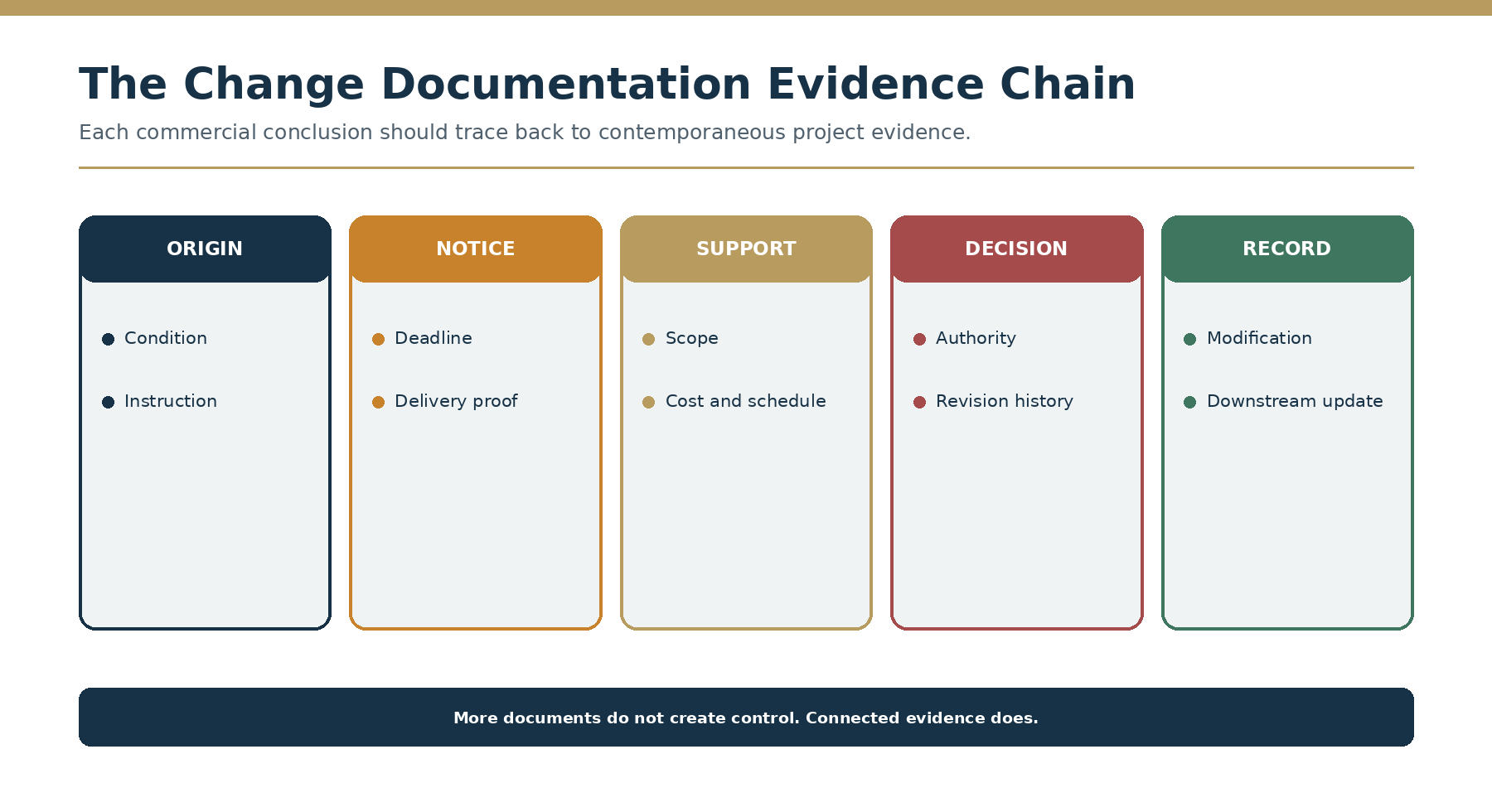
A defensible record connects, rather than merely stores:
- the originating event;
- controlling document and revision;
- notice and delivery evidence;
- instruction or authorization;
- scope development;
- subcontractor and supplier backup;
- labor, equipment, and material records;
- schedule status and analysis;
- proposal revisions;
- negotiation and decision history; and
- executed modification and downstream updates.
The point is traceability. A reviewer should be able to move from the signed modification back to the event and forward to cost, time, billing, and collection.
Documentation when work proceeds
When changed work begins before final agreement, documentation becomes more demanding. Use separate cost codes or work orders, daily labor and equipment tickets, material receipts, photographs, quantity records, subcontractor backup, daily verification where available, schedule narratives, and periodic exposure updates.
FAR 43.203 addresses segregable changed-work costs in federal contracting. Private work is governed differently, but the operational lesson is sound: cost buried in base codes is difficult to forecast, price, audit, or defend.
Schedule evidence
Preserve the accepted schedule update contemporaneous with the event. Identify affected activities, actual status, remaining float, required decisions, procurement dates, resequencing, mitigation, and any developing cumulative effect.
A later reconstructed analysis may still be useful, but it is generally less persuasive than records showing what the team knew and did at the time.
Delivery and proof
A notice process should capture recipient, sender, delivery channel, sent timestamp, received or acknowledged status, attachments, document version, and follow-up date. An email sitting in a project manager’s sent folder is not an enterprise notice system.
Documentation failure modes
- The daily report mentions extra work but no notice is issued.
- The RFI identifies the issue but does not state potential cost or time effect.
- A subcontractor sends backup after the prime contract deadline.
- Photos exist without date, location, description, or relationship to the changed work.
- Tickets combine base and changed work.
- Proposal revisions overwrite prior versions.
- Meeting minutes record a direction but not the authorized party.
- The record shows cost but no schedule consequence, or schedule delay without mitigation evidence.
Syntecton’s role
Syntecton can preserve the originating record and its relationships: a drawing revision becomes a potential change; the potential change connects to notice, pricing, schedule exposure, authorization, contract modification, downstream commitment, and billing. Role permissions prevent a supporting participant from changing commercial status or execution data.
The objective is not more documentation. It is a coherent, current, permission-controlled commercial record.