Construction Legal Risk: Documents, Authority & Audit Trails
Reduce preventable construction legal risk through controlled project records, authority, approvals, notices, permissions, audit history, and retention.
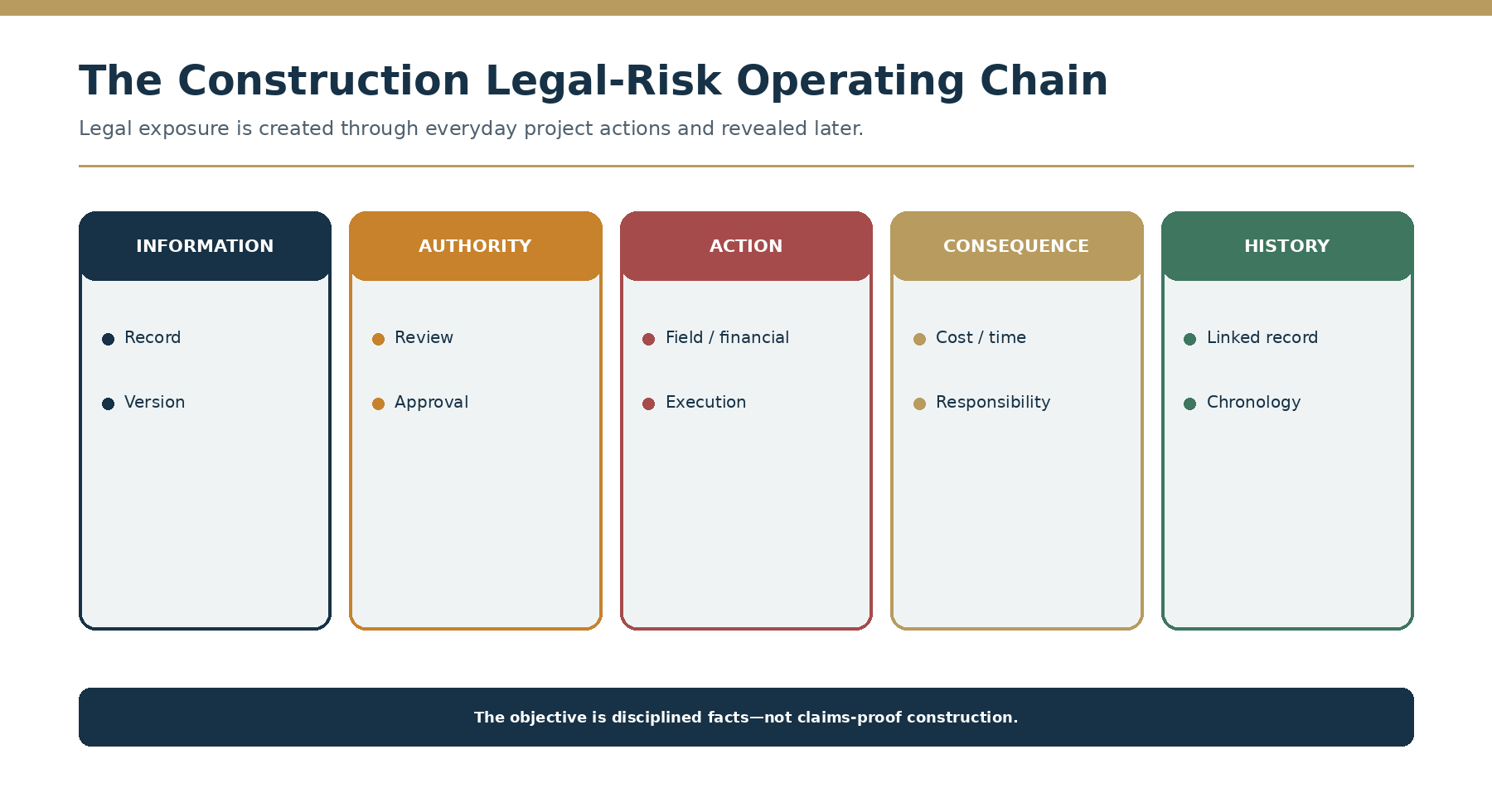
Construction legal risk rarely begins in a courtroom. It begins months or years earlier when a team builds from a superseded drawing, misses a notice deadline, acts without authority, approves price without resolving time, edits an official record without visible history, or cannot reconstruct who knew what and when.
Contracts establish rights and duties. Project teams create the facts that determine whether those rights can later be evaluated.
Modern construction therefore needs more than document storage. It needs a risk-aware operational record: controlled versions, defined authority, structured workflows, targeted distribution, linked records, restricted access, reliable timestamps, preserved history, and governed export.
Software cannot interpret every contract, establish entitlement, guarantee compliance, create privilege, or make an inaccurate record trustworthy. It can reduce preventable exposure by making required process explicit and preserving evidence of scope, communication, review, authority, timing, change, and follow-through.
Why construction is unusually exposed
A commercial project combines multiple contracts and tiers, distributed design responsibility, changing documents, hundreds of participants, physical work performed before every issue is settled, recurring payment rights, schedule dependencies, safety duties, electronic communication, and years between an event and a later dispute.
The record is decentralized by default. Architects issue drawings, engineers respond to technical questions, contractors coordinate trades, subcontractors prepare submittals, owners give direction, inspectors observe conditions, accounting processes money, and field teams document progress.
The risk is not merely that a file will be lost. It is that the company cannot establish the relationships among records.
An RFI response may appear minor until connected to the drawing it interpreted, the activity it delayed, the subcontractor that relied on it, the notice issued, the potential change, the cost incurred, and the owner’s decision. That chain—not the isolated PDF—is the project record.
Legal risk is operational risk
Disputes commonly involve scope, changes, delay, acceleration, differing conditions, defective work, payment, retainage, liens, bonds, design responsibility, safety, property damage, termination, warranty, insurance, and indemnity.
Software does not decide the legal result. It influences whether the organization:
- follows the configured contractual process;
- recognizes risk early;
- routes decisions to authorized people;
- preserves contemporaneous evidence;
- segregates cost and time;
- documents mitigation;
- protects restricted information; and
- produces a coherent chronology later.
Seven layers of control
Contract requirements
Extract project-specific notice, change, payment, schedule, document, insurance, closeout, dispute, and electronic-communication requirements. The software’s default workflow must not be assumed to match the executed agreement.
Authority
Define who may issue instructions, publish documents, respond to RFIs, approve submittals, direct changed work, approve price and time, execute contracts, certify payment, release funds, close high-risk findings, or reopen records.
Role, access, and authority are different. A project manager may administer a contract without authority to modify it.
Workflow
Separate draft, internal review, submission, external review, revision, approval, authorized action, execution, billing, performance, verification, rejection, dispute, and closure.
Permissions
Control view, create, edit, submit, respond, approve, execute, publish, supersede, reopen, export, and delete independently. Consider company, project, relationship, confidentiality, workflow state, and delegated limits.
Audit history
Record actor, organization, acting role, timestamp, record version, action, prior and new state, reason, delegation, notification result, source, and downstream effect.
Retention and preservation
Use record classifications, recoverable deletion, controlled disposition, and counsel-directed preservation where required.
Management visibility
Surface approaching deadlines, unauthorized attempts, performed unapproved work, changed official metadata, failed signatures, missing acknowledgements, abnormal access, incomplete downstream updates, and aged exposure.
From system of record to operational evidence
A conventional platform asks where the document is. A risk-aware operating system also asks which version governed, who published it, who received it, what decision referenced it, who had authority, what action followed, what downstream records changed, and whether the history remains intact.
The objective is not to manufacture a claim file. It is to operate consistently enough that ordinary records remain trustworthy and understandable.
How Syntecton is designed differently
Syntecton’s legal-risk value is not a separate legal module. It is the architecture connecting project records, permissions, approvals, notifications, workflows, signatures, financial actions, safety records, and audit history.
That supports the stronger position:
Construction legal risk is controlled through the integrity of everyday project operations.
Capabilities such as immutable evidence, formal legal holds, integrity hashes, custodian certification, or forensic chain-of-custody should not be claimed unless separately verified in the live application.
Implementation standard
Start by inventorying executed contracts and the workflows capable of creating material exposure. Define record classes, notice requirements, authority, delegated limits, confidentiality, signatures, retention, and escalation before configuring statuses.
Then test failure scenarios: an external participant attempts self-approval; a superseded drawing remains available in the field; a notice deadline arrives without a decision; a signed document changes after approval; an employee leaves with open commitments; restricted claim material reaches an ordinary distribution list; an integration updates only one financial record; and a preservation instruction conflicts with normal deletion.
The system is not risk-aware because it contains the right fields. It is risk-aware when a failed transition becomes visible and accountable.