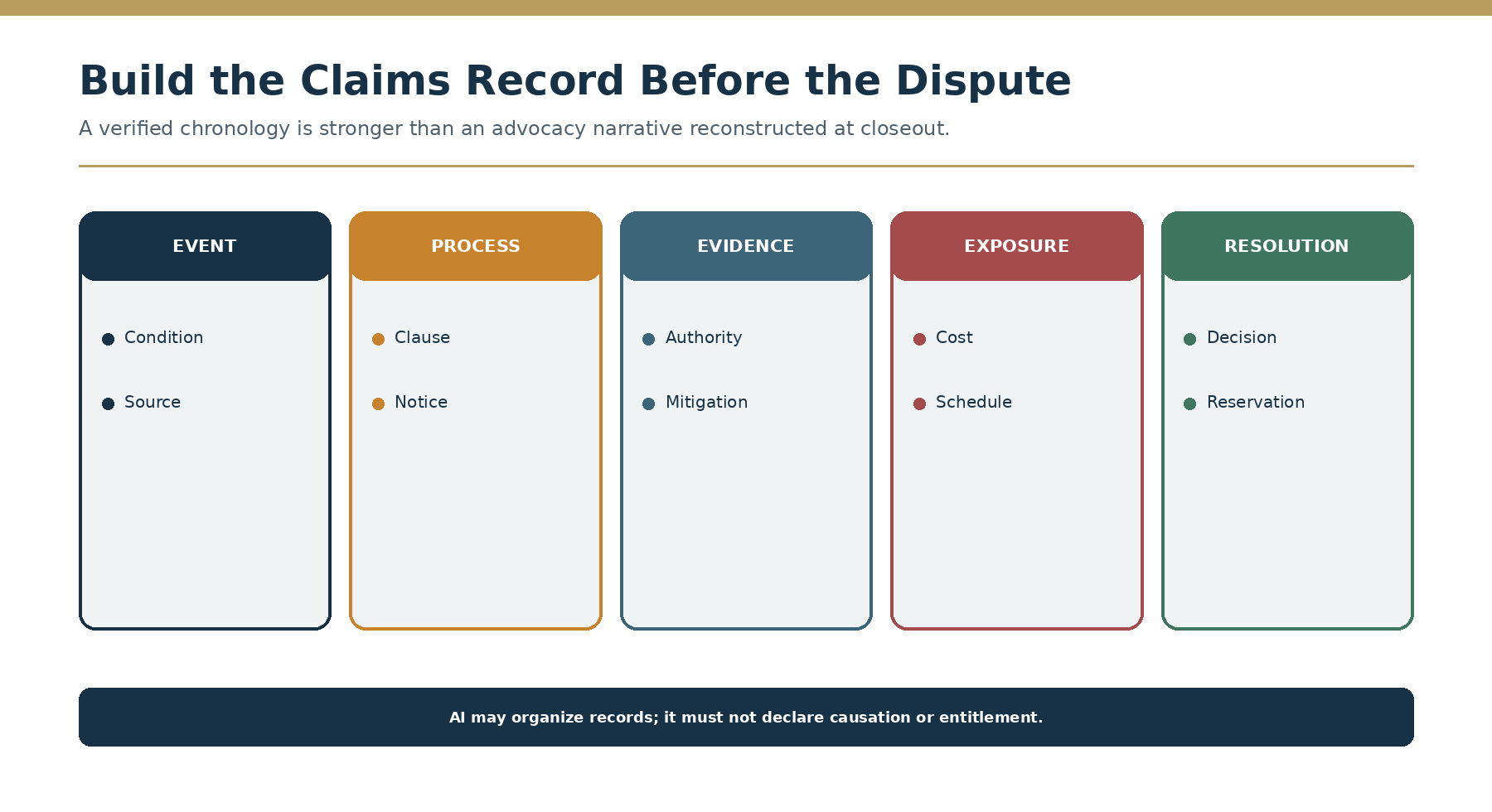
Construction Claims Documentation and Chronology Guide
Build a coherent construction claims record connecting events, contract requirements, notice, authority, causation, mitigation, cost, schedule, and resolution.
A claims file assembled after the project deteriorates is usually weaker than an ordinary project record created through disciplined operations.
Claims documentation should not begin with advocacy. It should begin with facts, contract requirements, chronology, responsibility, cost, time, mitigation, and unresolved decisions.
The claims record
Connect:
- originating event;
- controlling contract provisions;
- governing document and revision;
- discovery and notice dates;
- required recipients and delivery evidence;
- instruction and authority;
- scope and responsibility analysis;
- contemporaneous schedule status;
- incurred, committed, and forecast cost;
- mitigation efforts;
- proposal and response history;
- decisions, reservations, and objections; and
- final resolution or continuing dispute.
Chronology before narrative
Build the objective chronology first. Then identify contradictions, missing periods, changed positions, undocumented direction, and decision delay.
AI may help extract dates and summarize records, but a qualified person must verify sources, context, duplicates, time zones, and whether a communication was actually sent or acknowledged.
Notice
Notice is a frequent preventable failure. Track trigger date, deadline, clause, type, recipient, delivery method, draft, approval, sent content, proof, response, reservations, supplements, and linked cost and schedule records.
An in-app notification is not necessarily contractual notice. AIA A201 guidance illustrates that ordinary written notice and notice of claims may have different delivery provisions. The executed contract and modifications control.
Causation and mitigation
Do not document only the owner or designer action. Preserve the contractor’s response, available alternatives, schedule condition, mitigation measures, acceleration or resequencing, and contribution by other causes.
Software should organize evidence, not declare causation or entitlement.
Cost and time
Separate base work from changed or disrupted work using dedicated cost codes, tickets, labor, equipment, material, subcontractor, and general-conditions records. Preserve the contemporaneous schedule update and affected activities.
Do not assume approved price resolves time, or that incurred cost guarantees recovery.
Claims strategy and privilege
Ordinary project facts and restricted legal analysis should not be mixed carelessly. Labeling a document “privileged” does not create privilege. Counsel should define access, purpose, distribution, preservation, and export protocol.
Syntecton’s role
Syntecton can connect the originating field record, documents, notice, RFI, change process, cost, schedule, meetings, correspondence, approvals, and chronology through a single project record.
Its value is earlier operational control—not automatic claim generation or legal conclusions.
Claims-documentation stress test
Before asserting a position, determine what the contract required, when the event occurred and was discovered, whether notice followed the configured process, who directed the work, what scope was affected, which schedule update reflects the condition, what cost was incurred and forecast, what mitigation occurred, whether other causes contributed, and what remains disputed.
Frequent gaps include a final proposal without the initial field event, notice without proof of delivery, cost without segregated source, delay narrative without a contemporaneous schedule, instruction without authority, and photographs without date or location.
A risk signal should identify the gap while the project can still correct it. Waiting for claim preparation turns an operating omission into an evidentiary problem.