Construction Project Records as Evidence
Create reliable construction project records through contemporaneous daily reports, meeting decisions, emails, RFIs, photos, version control, and chronology.
Records created at or near an event are usually more useful than narratives reconstructed months later. That does not mean every contemporaneous record is accurate or automatically admissible.
The operational objective is consistency: record facts near the event, identify the source, distinguish observation from opinion, preserve versions, and prevent silent alteration.
Daily reports
A useful daily report records date, weather, workforce by employer and trade, work performed and location, equipment, deliveries, visitors, inspections, tests, safety events, delays, instructions, photographs, conditions, responsible author, and closing time.
Avoid copied text, vague entries such as “all normal,” unsupported blame, legal conclusions, retrospective batch creation, and edited history without visibility.
If a submitted report is reopened, the prior submission and reason should remain visible.
Meeting records
Minutes should distinguish:
- discussion;
- recommendation;
- action item;
- direction;
- approval; and
- contract modification.
Record attendees and organizations, decisions, responsible parties, due dates, objections or correction periods, linked records, and distribution. Attendance does not mean every participant agreed.
Emails and correspondence
Important communication should retain sender, recipients, timestamp, body, attachments, and thread context. Saving the attachment alone may remove why it mattered or who received it.
An email can communicate information without satisfying a contractually required notice method.
RFIs and submittals
An RFI response may clarify information or reveal changed work. It is not automatically a contract modification. A design comment is not automatically the official response.
A submittal review does not automatically transfer design, means-and-methods, field-verification, or coordination responsibility. The governing contract and review language control.
The system should preserve status, review authority, response version, relationships, distribution, and subsequent change consequences.
Drawings and photographs
A newer file is not automatically authorized for construction. Record issue purpose, publication authority, revision, supersession, distribution, acknowledgement, and linked decisions.
Photographs need date, location, description, source, and relationship to the relevant event. A folder of unlabeled photographs has limited operational value.
Regular business practice
Federal Rule of Evidence 803(6) addresses conditions for the records-of-regularly-conducted-activity exception in its federal context, including timing, knowledge, regular practice, foundation, and trustworthiness.
Software entry alone does not satisfy those conditions. Consistent ordinary-business procedures, identified sources, visible corrections, and preserved system context support a more reliable record.
Syntecton’s role
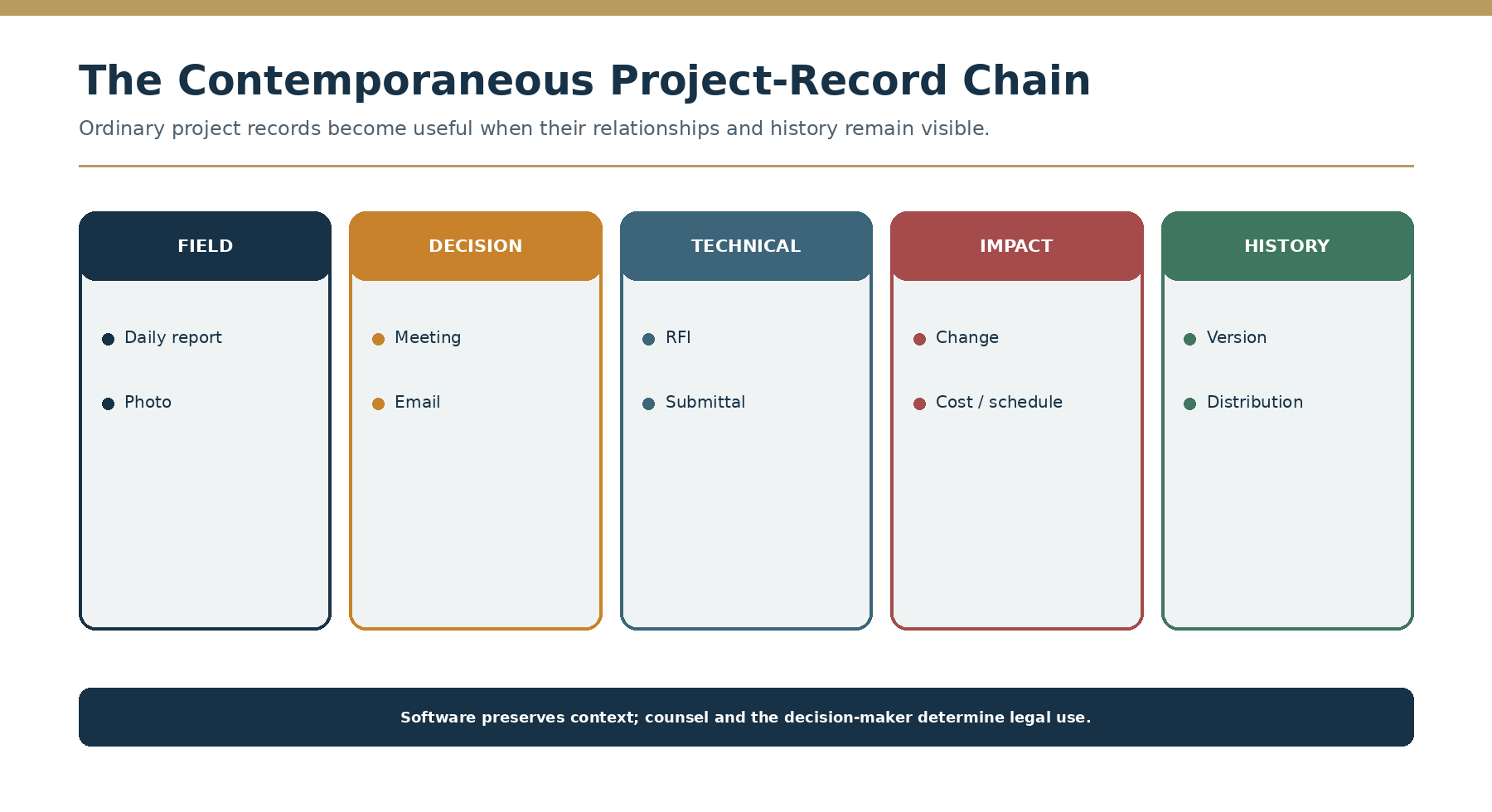
Syntecton connects daily logs, meetings, emails, drawings, specifications, RFIs, submittals, photographs, changes, cost, schedule, and field activity through the Project Record.
The value is not simply storing each record. It is preserving how the records relate to the project event and subsequent action.
Record-quality test
Ask whether the author records observation, third-party information, or opinion; whether timing is contemporaneous or reconstructed; whether location and affected revisions are precise; whether photographs are described; whether the record distinguishes discussion from direction; whether corrections remain visible; and whether resulting cost, schedule, safety, or quality actions are linked.
Copying prior daily reports, creating records in batches after a dispute, changing dates without history, recording legal conclusions as field facts, letting external users alter official metadata, and saving email attachments without thread context all weaken trust.
The objective is not defensive or over-lawyered writing. Record precise facts, source, action, and unresolved condition.