Construction Change Order Schedule Impact Guide
Evaluate how construction changes affect activities, float, critical path, procurement, sequencing, acceleration, time extensions, and time-related cost.
Construction teams commonly negotiate change-order dollars while treating time as a blank field or an automatic number of days. Both approaches are weak.
A five-day work duration does not automatically create a five-day contract extension. A proposal stating “zero days” without analysis may surrender a legitimate time position. Schedule impact must be evaluated against the actual project schedule and circumstances.
Start with contemporaneous schedule status
Preserve the accepted schedule update closest to the event. Identify:
- affected activity or milestone;
- actual progress at the event date;
- remaining duration;
- logic relationships;
- available float;
- procurement and approval dependencies;
- near-critical paths;
- imposed constraints;
- concurrent conditions; and
- planned mitigation.
The objective is to understand the change within the project state that existed when it occurred.
Direct and indirect time effects
A change may add physical duration, delay a decision, affect procurement, require redesign, cause resequencing, stack crews, reduce productivity, alter inspections, extend commissioning, or shift work into adverse weather.
The time consequence may therefore differ from the duration of the added work.
Available positions
The workflow should support more than “days”:
- no time impact;
- defined requested extension;
- defined approved extension;
- time impact reserved pending analysis;
- time extension without direct added cost;
- acceleration cost without time extension;
- concurrent delay position;
- mitigation or resequencing proposal;
- cumulative-impact concern; or
- disputed impact.
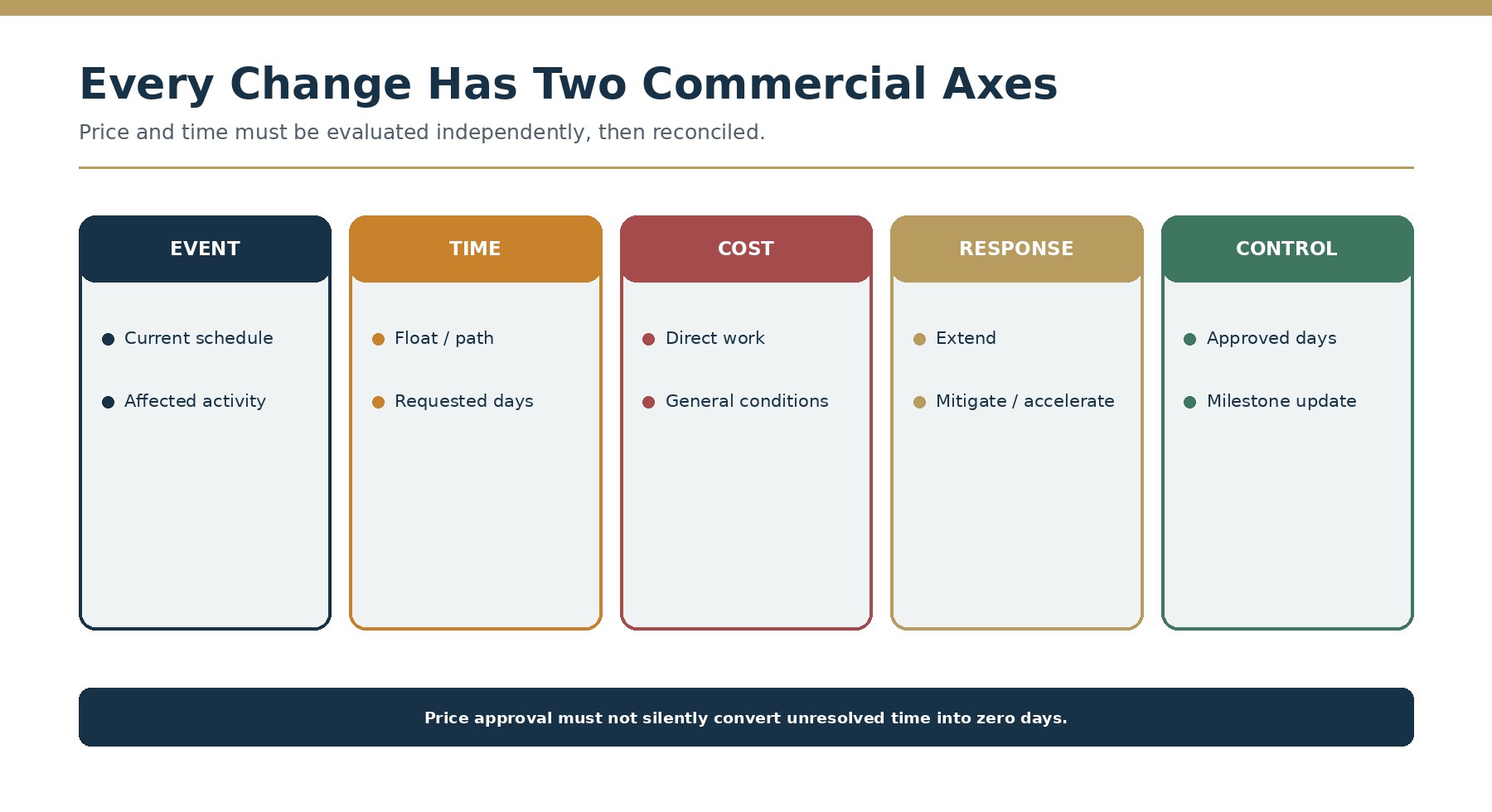
Price approval should not silently convert an unresolved time position into zero days.
General conditions and time-related cost
An extension can affect supervision, trailers, utilities, security, temporary facilities, insurance, equipment, project management, and other time-related cost. Recoverability depends on the contract and causation.
The estimate should distinguish the cost of added work from the cost of extended duration. That allows the parties to evaluate alternatives such as extension, acceleration, resequencing, or partial mitigation.
Acceleration
Acceleration may be expressly directed or may arise from circumstances in which the completion requirement remains unchanged despite excusable delay. The contractual and legal analysis is project-specific.
Operationally, the team should document the schedule condition, direction, requested recovery plan, added shifts or overtime, crew stacking, productivity effect, equipment, procurement measures, cost, and outcome.
Do not assume overtime equals acceleration success. Added hours can reduce productivity and introduce safety or quality risk.
Cumulative effects
Individually modest changes can create a combined effect through repeated disruption, resequencing, congestion, decision delay, and trade interference. A change system should preserve relationships among related events and schedule updates.
AI or analytics may flag repeated conditions or growing near-critical exposure, but it should not declare causation or entitlement.
Approval and schedule control
Once a time adjustment is authorized, update contractual milestones and the controlling schedule through governed actions. Retain requested, analyzed, and approved days separately so the record shows the negotiation.
Downstream subcontract time should also be evaluated. A prime-contract extension does not automatically determine every subcontractor’s entitlement or responsibility.
Syntecton’s role
Syntecton can connect the originating event and commercial record to affected schedule activities, required decisions, requested days, approved days, mitigation, general-conditions exposure, and contractual milestone updates.
The objective is not automated delay analysis. It is preventing time from disappearing during price negotiation.