Construction Change Directives and Directed Work Guide
Understand construction change directives, authority, reservations, cost segregation, daily tickets, schedule records, and conversion to final agreement.
Projects sometimes cannot wait for a fully negotiated change. Safety, access, procurement, sequencing, or owner requirements may require changed work to proceed before price and time are settled.
That situation is not the same as an executed change order. It is a controlled exception that requires stronger documentation and clearer authority.
Directive versus change order
An executed change order records agreement. A construction change directive may direct work before the parties agree on the final contract-sum or contract-time adjustment.
AIA describes G714 for changes in the work when the owner and contractor have not yet agreed on adjustments to contract sum or time. Its instructions contemplate later preparation of a change order when agreement is reached under the applicable contract process.
Other contract families use different instruments. The executed agreement determines who may issue direction, what work must proceed, how price is determined, how objections are preserved, and how unresolved matters enter the claims process.
Verify authority
Field urgency does not expand authority. A project should establish an authority matrix before work begins:
- who may identify a potential change;
- who may request pricing;
- who may direct immediate protection;
- who may authorize directed work;
- who may approve subcontract changes;
- who may modify prime-contract sum or time; and
- what dollar limits apply.
FAR 43.202 limits issuance of federal change orders to the contracting officer unless authority is properly delegated. Private contracts differ, but the control principle applies: a person’s project involvement does not automatically give them modification authority.
Authorization is not final entitlement
A valid direction to proceed may establish an obligation to perform without resolving final price, time, responsibility, or recoverability. Conversely, a contractor’s belief that work is extra does not itself authorize performance.
The system must therefore preserve separate fields for:
- direction and directing party;
- authority basis;
- contractor response;
- reservations or objections;
- pricing method;
- requested and determined contract adjustment;
- requested and determined time;
- disputed matters; and
- conversion to executed modification.
Controls for directed work
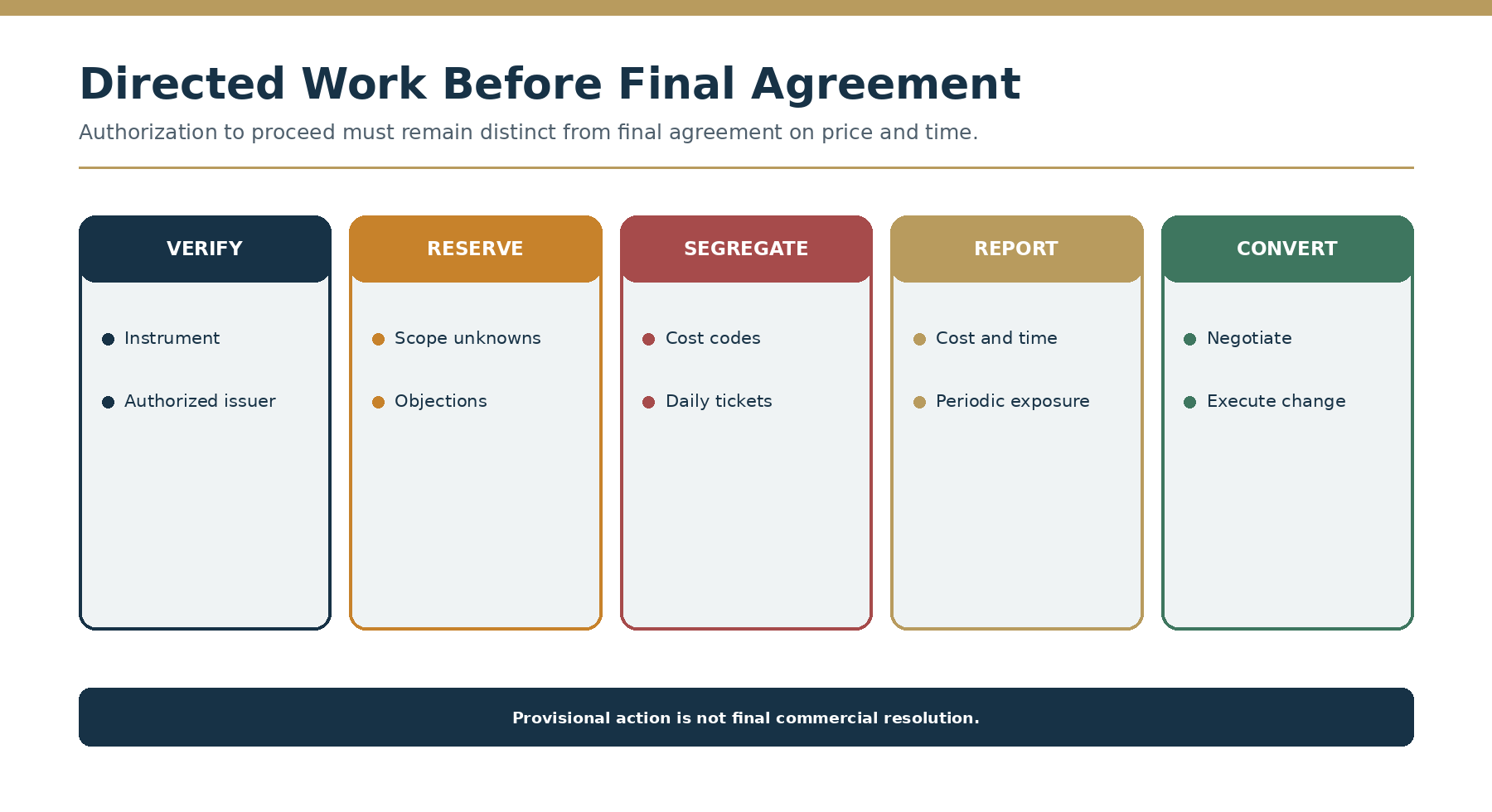
When properly directed work begins:
- confirm the instrument and authorized issuer;
- identify the scope as presently understood;
- state reservations and unknowns promptly;
- create dedicated cost codes or work orders;
- use daily labor, material, and equipment tickets;
- obtain daily verification where possible;
- photograph progress and conditions;
- track schedule effects and mitigation;
- submit periodic cost and time updates; and
- escalate unresolved scope or authorization.
Do not wait until project closeout to reconstruct the cost.
Time-and-material and force-account work
Daily tickets should identify date, location, activity, worker classification, hours, equipment, materials, quantities, subcontractors, base work excluded, and verifier. A signature may confirm that resources were observed; it may not constitute agreement on entitlement, rates, markup, productivity, or final value unless the contract says so.
The ticket workflow should make that distinction visible.
The owner’s exposure
Owners also need control. Directed work can accumulate rapidly while the final value remains unknown. Periodic exposure reporting should show incurred cost, committed cost, forecast-to-complete, requested value, amount accepted, disputed components, schedule position, and next decision.
Silence harms both parties: the owner loses visibility and the contractor loses contemporaneous proof.
Conversion to final modification
Once agreement is achieved, the executed modification should identify the final scope, contract adjustment, time adjustment or reservation, incorporated exhibits, and treatment of prior directives and payments. Downstream subcontract and purchase-order modifications must then be reconciled.
Syntecton’s role
Syntecton can maintain the directive as a distinct commercial state rather than mislabeling it “approved.” It can capture authority, reservations, daily tickets, segregated cost, schedule exposure, ongoing negotiation, and eventual conversion into an executed modification.
That distinction protects the audit record and prevents provisional action from being reported as final agreement.