Pending Change Orders: Cost, Margin and Cash Exposure
Manage pending construction changes by separating incurred cost, commitments, forecast cost, proposed and approved contract value, billing, collection.
Pending change orders are often treated as a paperwork backlog. They are actually a portfolio of unresolved cost, contract-value, margin, schedule, and cash risks.
The central forecasting mistake is symmetrical: some teams hide probable cost until owner approval, while others assume full proposed recovery before agreement. Both distort margin.
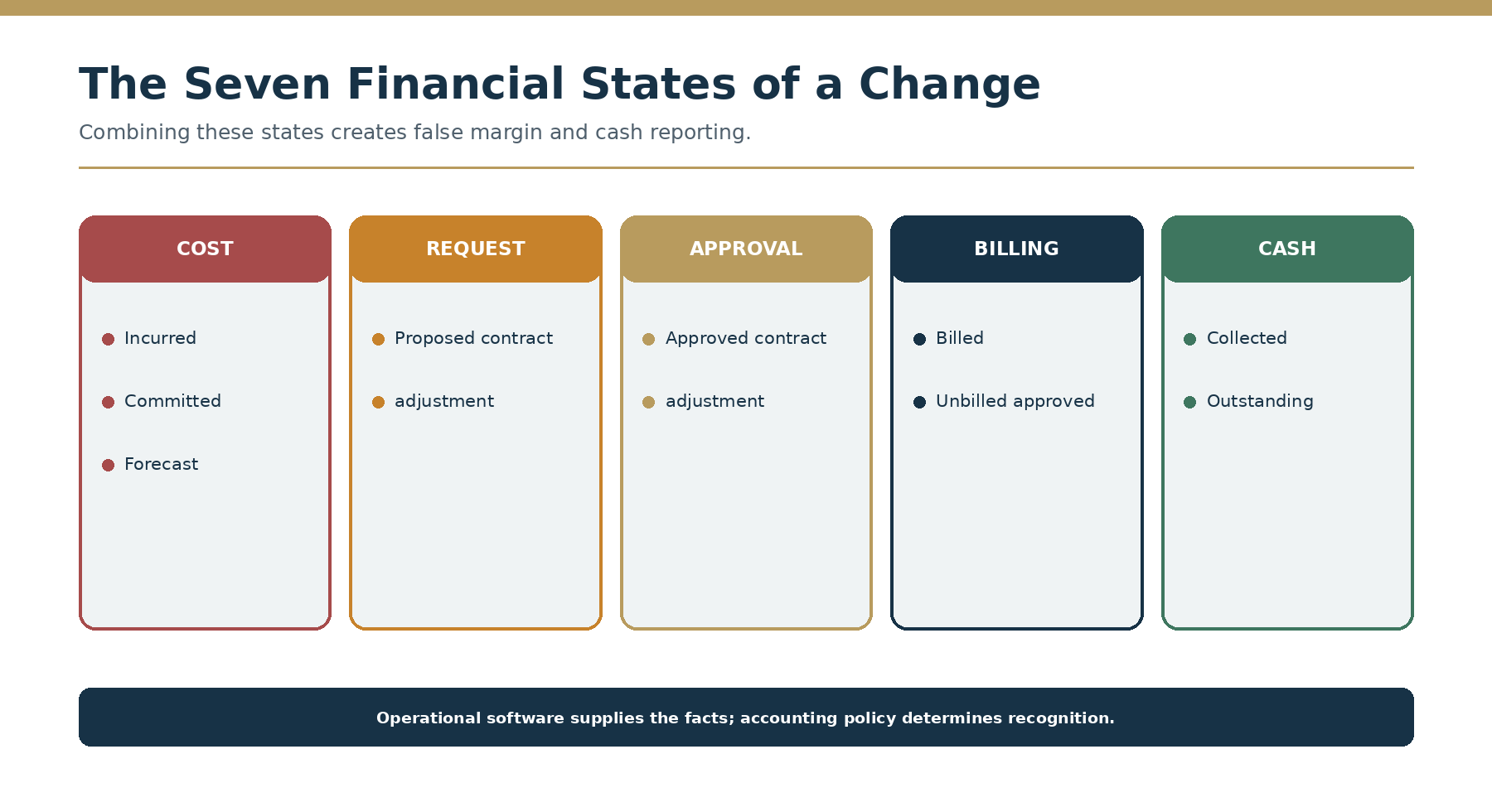
Seven financial states
Every material change should distinguish:
- Cost incurred: Cost already recorded for performed work.
- Cost committed: Contractual or purchase exposure not yet fully incurred.
- Forecast cost: Expected total cost at completion for the change.
- Proposed contract adjustment: Amount requested from the upstream party.
- Approved contract adjustment: Amount formally incorporated or otherwise approved under the governing process.
- Billed amount: Approved or otherwise eligible value included in billing.
- Collected amount: Cash received and applied.
These are operating states, not accounting conclusions. Recognition of revenue and treatment of variable consideration or contract modifications requires the company’s applicable accounting framework and professional judgment. FASB Topic 606 contains contract-modification guidance; operational software should supply controlled facts rather than silently make the accounting determination.
The margin illusion
Suppose a change has $200,000 forecast cost and a $250,000 proposal. Reporting the full $50,000 projected margin as certain ignores approval risk. Reporting no cost because the proposal is pending overstates the base contract margin.
Management reporting should show at least:
- forecast cost exposure;
- proposed contract value;
- approved contract value;
- assessed recovery position under company policy;
- unapproved cost exposure;
- approved but unbilled value;
- billed but uncollected value; and
- remaining downside.
Probability labels should not become arbitrary optimism. They require defined criteria, responsible review, and documentation.
Aging reveals governance failure
Total pending value shows scale. Aging shows process failure. A smaller 120-day disputed change may be more dangerous than a large proposal submitted last week.
Track:
- event-to-notice days;
- notice-to-price days;
- days awaiting subcontractor backup;
- days awaiting design response;
- days awaiting owner decision;
- days since last action;
- work performed before approval;
- unapproved incurred and committed cost;
- unresolved schedule position;
- days from approval to execution;
- days from execution to billing; and
- days from billing to collection.
Every aged item should have a next action, owner, and due date.
Portfolio segmentation
Executives should distinguish:
- awaiting internal pricing;
- awaiting external information;
- submitted and under review;
- partially approved;
- directed work with open adjustment;
- disputed entitlement;
- rejected but not closed;
- approved but not executed;
- executed but unbilled; and
- billed but unpaid.
One “pending” bucket makes operational intervention impossible.
Upstream and downstream exposure
The owner-facing change and subcontractor-facing commitment often mature at different speeds. A contractor may have downstream cost without upstream recovery, upstream approval without finalized buyout, or mismatched scope between the two.
The forecast should reconcile both sides rather than assuming that one approval automatically resolves the other.
Weekly decision rhythm
A short weekly change-control meeting should focus on new events and notice deadlines, work proceeding without final price, proposals due, overdue external decisions, oldest changes, largest unapproved cost, unresolved schedule impacts, approved changes not executed, executed changes not billed, and collected changes not reconciled downstream.
Reading the log aloud is administrative theater. Each item must leave with a decision, accountable owner, or escalation.
Syntecton’s role
Syntecton can surface pending exposure at project and company level without merging its financial states. A field event can carry forecast cost before recovery is approved; approval can update the contract through controlled workflow; billing and collection remain visible afterward. See Financial Management and the related change order management guide.
This allows executives to forecast with less fiction.