Construction Change Order Software: Evaluation Guide
Evaluate construction change order software for source-event linkage, notices, pricing, schedule impact, permissions, forecasting, contracts, and billing.
A spreadsheet can list change numbers, descriptions, proposed amounts, approved amounts and status. That is sufficient for a basic log. It is not a change-control system.
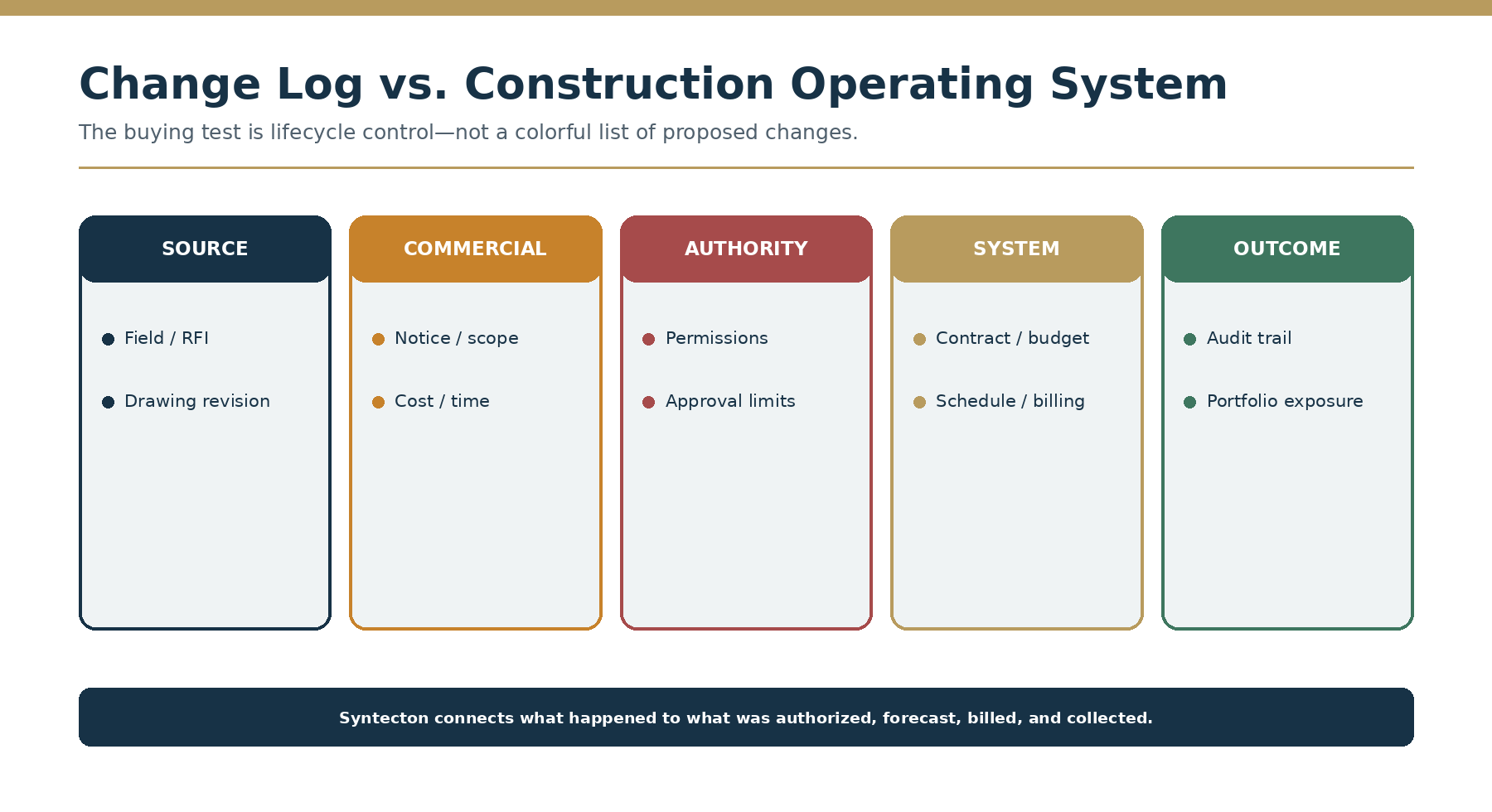
The real software problem is maintaining a controlled chain across field evidence, contract requirements, commercial analysis, authorization, cost, time, contract modification, downstream commitments, billing and collection.
Source-event linkage
The system should create a potential change from an RFI, drawing revision, field report, meeting commitment, owner request, inspection finding or correspondence item while retaining the originating record and document revision.
Without that relationship, teams reconstruct context from attachments and memory.
Notice control
Software should support project-specific notice deadlines, recipients, delivery evidence, supplements, reminders and links to contract requirements. A generic “notification sent” field is inadequate when timing and recipient matter.
Commercial state
The data model should separate:
- event and potential change;
- notice;
- entitlement position;
- authorization;
- scope;
- pricing;
- time impact;
- proposed contract adjustment;
- approved adjustment;
- execution;
- billing;
- collection; and
- dispute or rejection.
A single dropdown called “pending/approved/rejected” is structurally too weak.
Cost and price development
The system should support labor, burden, material, equipment, subcontractor proposals, bonds, insurance, markups, credits, indirect effects, general conditions, escalation and pricing revisions. It should reconcile forecast cost against proposed and approved contract value.
Once work begins, dedicated cost codes or work orders should preserve changed-work cost.
Schedule integration
Requested, analyzed and approved days should remain distinct. The record should link to activities, milestones, schedule updates, procurement constraints, mitigation, acceleration and reservations.
Approving dollars should not automatically set time impact to zero.
Permission architecture
This is a critical procurement test. A subcontractor may need to identify an event, upload backup, price scope and respond to revision requests. That does not mean the subcontractor should mark the owner change approved, enter an execution date, modify the prime contract or authorize payment.
Permissions should control:
- creation;
- visibility;
- editing;
- submission;
- internal review;
- external transmission;
- approval;
- execution;
- contract modification;
- billing eligibility; and
- reopening or reversal.
Role alone may not be enough. Authority can depend on project, contract, workflow state, company and dollar limit.
Version and audit history
Every proposal revision should remain available. The system should show who changed scope, price, time, status, authorization or execution data; when they changed it; the prior value; and any supporting reason.
An audit log is not merely an IT feature. It protects commercial authority and explains the project’s reported state.
Downstream updates
Approval is not the end. Controlled actions should update:
- prime contract value and time;
- budget and forecast;
- subcontract and purchase-order commitments;
- schedule and milestones;
- schedule of values;
- pay-application eligibility;
- owner and vendor billing;
- accounting integration; and
- portfolio exposure.
The system should avoid uncontrolled automatic changes. Consequential updates require review, permissions and traceability.
Executive reporting
Useful reporting includes unapproved cost exposure, proposed and approved contract value, aging by workflow cause, directed work without final agreement, owner-versus-subcontract reconciliation, unresolved time impact, approved-unexecuted value, executed-unbilled value and billed-uncollected value.
Dashboards must preserve uncertainty rather than converting every proposal into expected revenue.
Where AI can help
AI can summarize source records, draft narratives, identify missing backup, compare revisions, flag stale items and surface cost or schedule inconsistencies. It should not invent entitlement, approve pricing, determine contractual authority or recognize revenue.
How to evaluate a demonstration
The same discipline that separates a real evaluation from a feature tour applies here. Ask the vendor to take one real change from field event through collection:
- Where did the event originate?
- Which contract and document revisions control?
- How was notice tracked?
- Who was allowed to authorize work?
- How were cost and time developed?
- How were incurred cost and proposed recovery separated?
- Who could approve and execute?
- What downstream records changed?
- What remained in the audit trail?
- How did the system show unresolved exposure?
If the demonstration ends at a colorful change log, the product has not demonstrated lifecycle control.
Syntecton as a Construction Operating System
Syntecton’s advantage is not that it digitizes a change-order form. It connects the field record, document control, notices, RFIs, schedule, budget, contracts, commitments, billing and executive risk view inside one permission-controlled operating system.
That architecture closes the gap between what happened in the field and what the company ultimately authorized, forecast, billed and collected.