Construction Change Order Pricing and Markup Guide
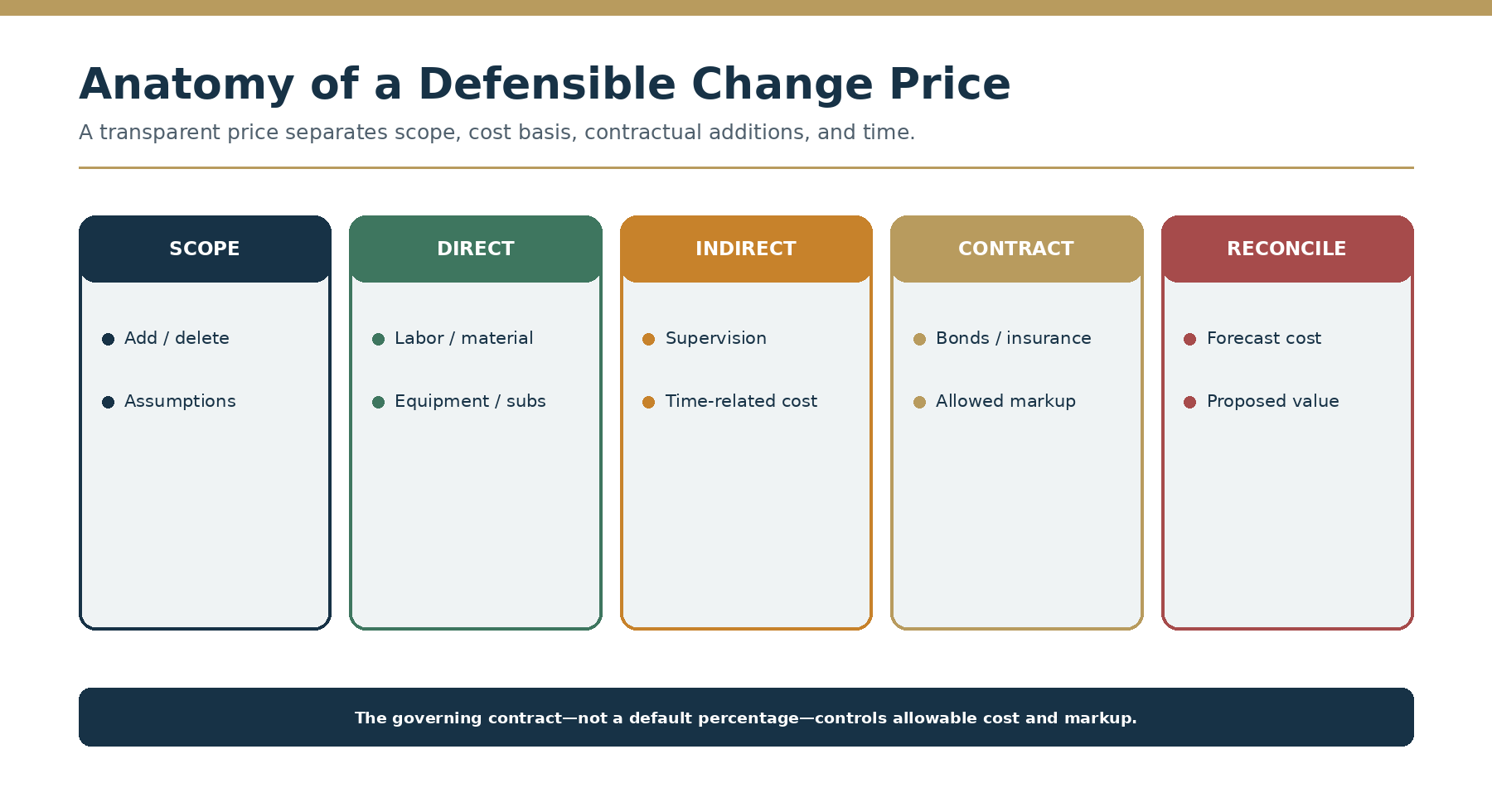
Price construction changes using defined scope, direct cost, labor burden, subcontractor backup, credits, allowable markups, indirect effects.
Change-order pricing fails when a proposal is treated as a marked-up subcontractor quote instead of a commercial estimate tied to defined scope and contract rules.
The disciplined sequence is scope first, price second. If assumptions, exclusions, document references, demolition, rework, adjacent-trade effects, testing, procurement, and schedule consequences are unresolved, the price is not stable.
Establish the pricing basis
The proposal should identify:
- exact added, deleted, or revised work;
- controlling drawings, specifications, sketches, RFIs, and directives;
- assumptions and exclusions;
- quantities and measurement basis;
- access, protection, temporary work, cleanup, and remobilization;
- demolition and rework;
- effects on adjacent trades;
- testing, permit, design, commissioning, and closeout requirements;
- procurement lead time and escalation;
- schedule and sequencing assumptions; and
- price-validity period.
This scope basis should remain versioned. A negotiated reduction that also removes scope is not a price concession; it is a revised commercial package.
Direct cost
Direct-cost development normally addresses labor hours and rates, labor burden, material quantities and unit prices, equipment, subcontract work, freight, tax, bonds, and insurance where permitted.
Labor should distinguish base wage, payroll taxes, insurance, benefits, union burdens where applicable, and company-specific allocations allowed by the contract. Avoid applying a separate burden percentage when the stated labor rate is already fully burdened.
Material pricing should identify quantity, waste, quotation date, freight, tax, storage, escalation, and cancellation or restocking exposure. Equipment should distinguish owned-equipment rates, rental, operators, mobilization, and standby treatment.
Subcontractor proposals
A subcontractor quotation is supporting input, not proof of prime-contract entitlement or reasonable price. Review its scope, exclusions, quantities, labor basis, schedule effect, tiered markup, insurance, bonds, credits, and relationship to the prime request.
The general contractor should also reconcile upstream and downstream positions. Owner approval for $100,000 does not automatically justify a $100,000 subcontract modification, and a $100,000 subcontract exposure does not guarantee equivalent owner recovery.
Indirect and time-related effects
Changes can affect supervision, temporary facilities, project management, field office, equipment, insurance, escalation, congestion, inefficiency, resequencing, testing, commissioning, and general conditions.
Whether those costs are recoverable depends on the contract and facts. They should not be hidden inside direct labor or an unexplained lump sum.
Markups
Contracts may define markup percentages, permitted bases, tiers, exclusions, and caps. The estimate should show which cost categories receive markup and prevent compounding where a base already contains fee or burden.
Percentages in examples are not market standards. The governing agreement determines allowable treatment.
Deductive changes
A deletion is not automatically the original estimate reversed. Determine avoided cost, design and procurement already performed, fabrication status, cancellation charges, restocking, demobilization, remobilization, and work already installed.
The commercial question is what cost is actually avoided—not what number originally appeared in the estimate.
Cost and contract value must reconcile
For every proposal, show:
- incurred cost;
- committed cost;
- remaining forecast cost;
- total forecast cost;
- proposed contract adjustment;
- approved contract adjustment;
- pending difference; and
- projected margin or loss, subject to company accounting policy.
This exposes a dangerous condition: work can be profitable on the proposed value but loss-making at the probable approved value.
Proposal review
Before submission, verify math, duplicate cost, labor burden, scope completeness, subcontractor coverage, credit treatment, markup rules, schedule cost, exclusions, document references, authorization status, and consistency with the forecast.
Negotiation history should preserve every revision. Overwriting the original proposal destroys the explanation of how scope and price changed.
Syntecton’s role
Syntecton can connect proposal pricing to the originating event, subcontractor backup, dedicated cost codes, forecast, owner contract, downstream commitments, schedule impact, and approval workflow. It can also restrict who may change price status, approval, and execution data.
The software should not decide entitlement or allowable markup. It should enforce structure, calculation transparency, version history, and commercial authority.