AI for Construction Documents, RFIs and Submittals
Learn how AI can support construction document search, specification extraction, RFIs and submittals without replacing professional verification.
Construction document problems are rarely caused by the absence of information. They are caused by the difficulty of finding the right information, confirming that it is current and connecting it to the work.
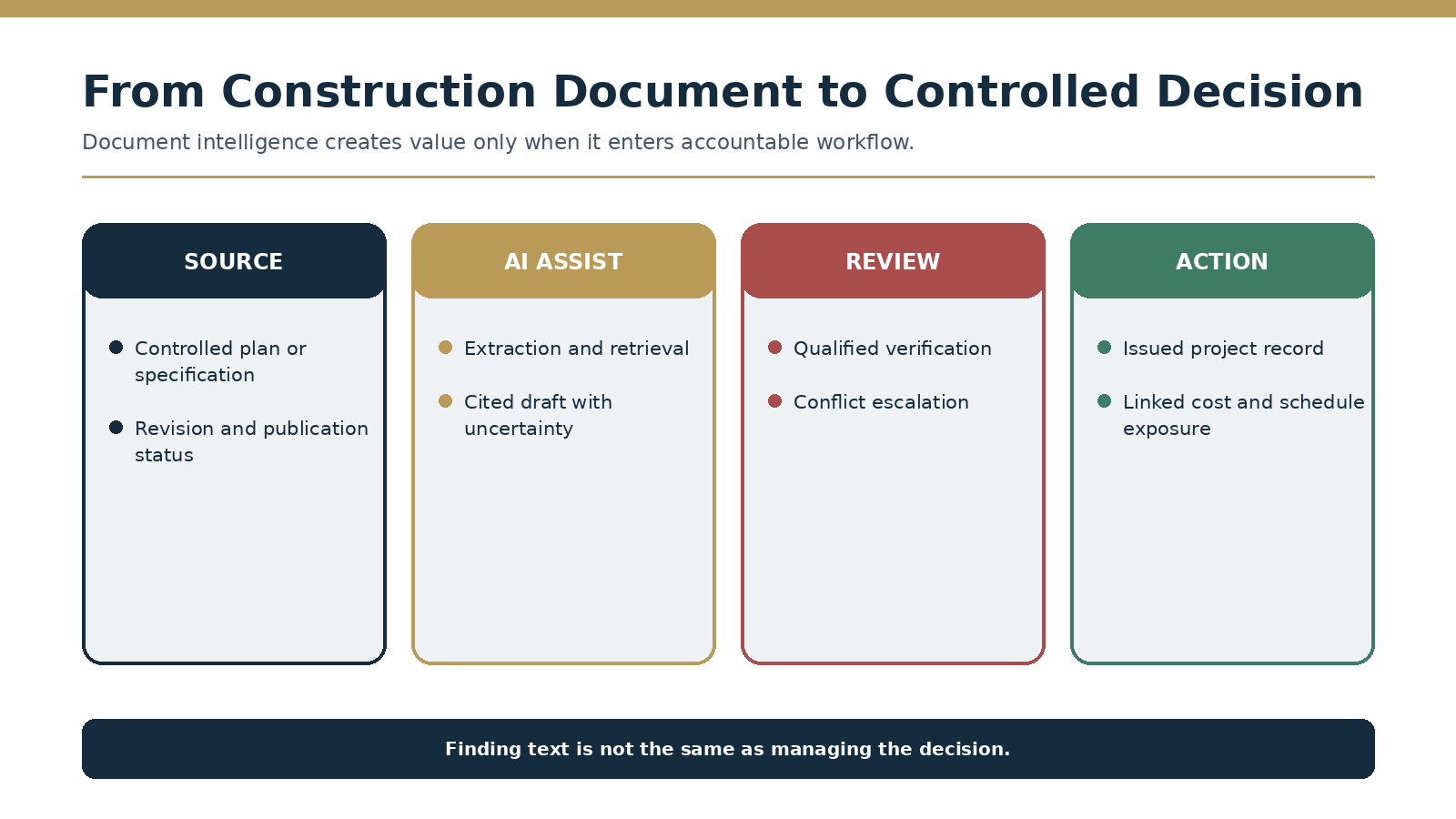
AI can improve document retrieval and preparation. It can also create false confidence if the system treats every file as equally authoritative.
The document-control problem
A project team may work with thousands of drawing sheets, specification pages, submittals, RFIs, sketches, meeting records and correspondence items. Requirements are distributed across documents and revised over time.
A user asking, “What waterproofing system is required?” may need information from a specification section, detail, approved substitution, submittal response and RFI. A one-document answer may be technically accurate but operationally incomplete.
What AI can do
AI-assisted document processing can:
- identify specification sections, titles and referenced standards;
- extract product, testing, warranty and closeout requirements;
- summarize long narratives;
- find semantically related records;
- compare revisions;
- propose metadata;
- classify uploaded files; and
- draft records using cited project information.
These functions are useful when the original source remains accessible and the user can verify the result.
Where extraction breaks down
Scanned pages, low-quality OCR, schedules, legends, symbols, tables, addenda and nested cross-references can create errors. Requirements may also conflict. An addendum may modify the specification while an approved RFI modifies the practical direction.
The system should not silently resolve those conflicts. It should show the competing sources and identify their status.
AI-assisted RFIs
An effective RFI workflow can use AI to assemble a draft from:
- the observed condition;
- drawing and specification references;
- related submittals and prior RFIs;
- responsible discipline;
- required response date; and
- potential schedule or cost exposure.
The project manager or superintendent should verify the facts and remove argumentative or contractual language that is not intended. AI should not manufacture a conflict to make an RFI sound complete.
AI-assisted submittals
AI may help extract the submittal register, compare submitted content with identified requirements, summarize review comments and track procurement exposure.
It should not represent that a product complies merely because matching words appear in a document. Compliance may depend on technical properties, assemblies, coordination, delegated design and professional judgment.
Revision intelligence
Simple file comparison is not enough. A useful process should:
- identify the controlling revisions;
- show what changed;
- connect changes to affected records and work packages;
- identify open decisions;
- notify appropriate roles; and
- preserve the prior record.
AI can assist with the second and third steps. Publication authority and distribution accountability remain governed workflow functions.
Source-grounded project questions
A credible project answer should include:
- the answer or summary;
- source record and revision;
- page or location where practical;
- status of the source;
- conflicting evidence;
- access-based filtering; and
- an uncertainty statement when the record is insufficient.
Without those controls, natural-language search can become a more persuasive form of document confusion.
Syntecton’s role
Syntecton’s opportunity is to connect document intelligence with the records that execute the work. Plans and specifications should not be an isolated repository. They should relate to RFIs, submittals, meetings, inspections, deficiencies, schedule exposure and commercial workflows.
That connection is the difference between finding text and managing a construction decision.