Construction Safety Software: Evaluation Guide
Evaluate construction safety software for inspections, observations, corrective actions, incidents, near misses, OSHA records, training, and certifications.
Many products digitize checklists. A construction safety operating system must connect the full control chain from hazard observation to verified correction, incident learning, recordkeeping, training, and executive oversight. This guide offers a product-agnostic framework for evaluating that chain, drawing on the discipline described in the construction safety management guide.
Verified Syntecton capability inventory
Syntecton currently supports:
- OSHA Forms 300, 300A, and 301;
- recordable, restricted-duty, and lost-time classifications;
- computed TRIR and DART;
- incidents and near misses through investigation and documented closeout;
- the Safety Triangle across observations, near misses, first aid, recordables, and lost-time outcomes;
- Toolbox Talks with attendance, individual sign-off, action items, and comments;
- observations;
- Safety Inspections with checklist templates;
- certifications with expiration and renewal reminders;
- days without incident;
- a company-wide Safety & Quality rollup;
- a dedicated Analytics Hub tab; and
- audit-ready incident, observation, OSHA, and toolbox-talk PDF exports.
These are product facts, not roadmap claims.
The buying criteria
Field usability
Can a worker or supervisor report an observation, near miss, or incident quickly? Can the system capture project, location, activity, employer, severity, evidence, and immediate protection without forcing irrelevant fields?
Corrective-action control
Does the workflow assign owners and deadlines, escalate by severity, separate correction from verification, reopen failed controls, and identify repeat findings?
Incident governance
Can the system restrict medical and investigation information, preserve evidence, support causal analysis, assign corrective actions, and document closeout?
OSHA recordkeeping
Does it maintain 300, 300A, and 301 records; preserve classification history; support restricted-duty and lost-time data; compute TRIR and DART from controlled inputs; and export usable records?
Software must not imply that an internal entry completes severe-event reporting, annual posting, electronic submission, or every State Plan obligation.
Training and participation
Can it document toolbox-talk attendance and individual sign-off, retain questions and actions, track certifications and expiry, issue renewal reminders, and distinguish attendance from qualification?
Analytics
Can executives see leading and lagging indicators without hiding critical exposure inside one score? Does the system interpret rising near-miss reporting cautiously and prevent days-without-incident from becoming an incentive for silence?
Permissions and audit trail
Subcontractors should participate without seeing restricted incident details or independently verifying their own critical corrections. The system should record changes to classification, severity, assignment, closure, OSHA status, and exports.
AI’s proper role
AI can draft toolbox-talk content, summarize inspections, suggest categories, translate field communication, identify repeat patterns, and flag incomplete records.
AI should not make final recordability determinations, diagnose medical conditions, certify OSHA compliance, close high-risk findings without verification, or replace qualified safety authority.
What “audit-ready” should mean
An audit-ready export should be organized, dated, complete, traceable, and supported by source records. It does not mean that every entry has been legally validated or that an agency, owner, insurer, or attorney will agree with every classification.
Syntecton as a Construction Operating System
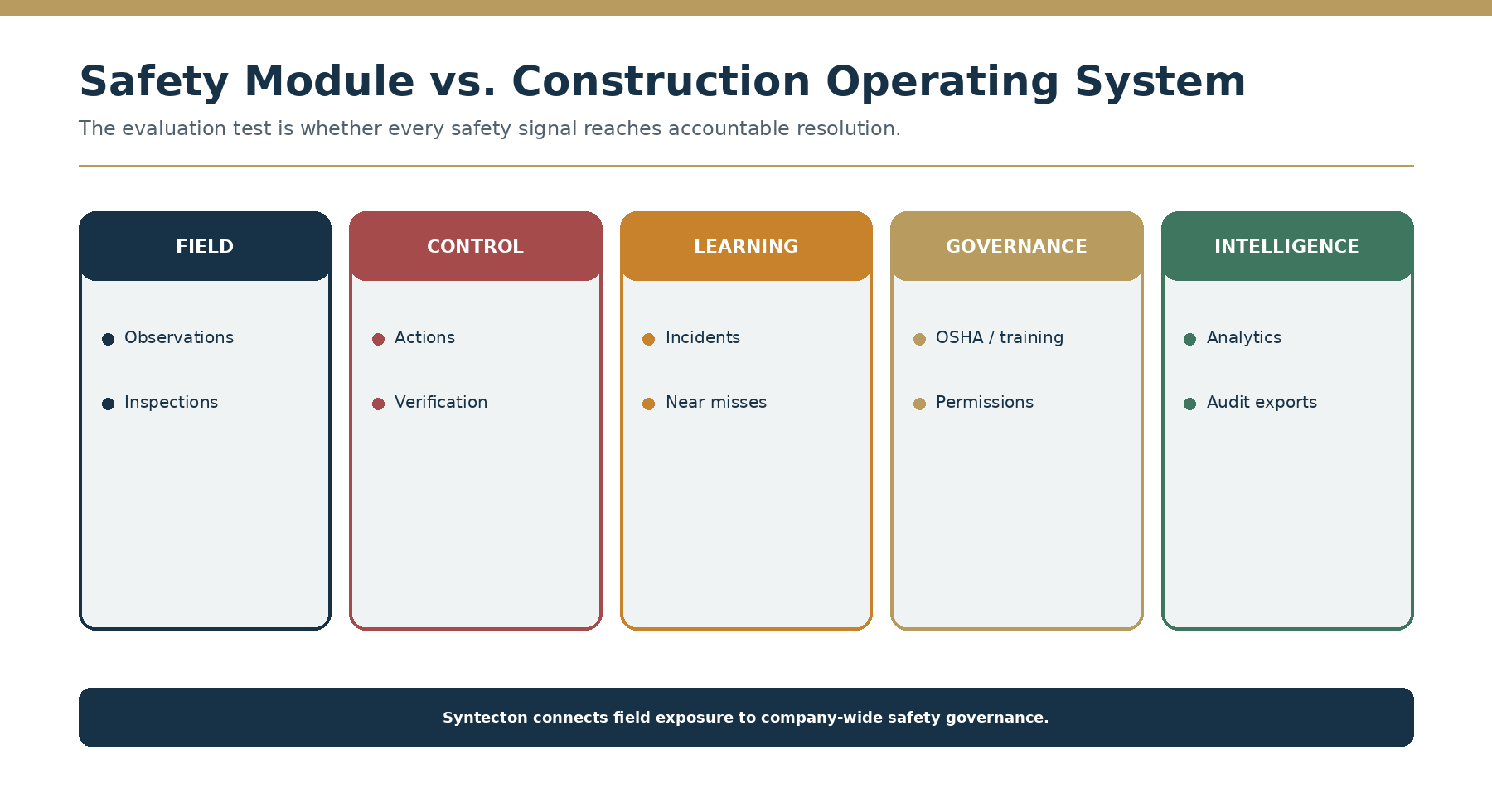
Syntecton connects field participation, inspections, corrective actions, incidents, near misses, training, certifications, OSHA records, analytics, permissions, and exports in one operating environment.
That is the gap between digitizing safety paperwork and managing safety as a company-wide control system.
Procurement red flags
- One generic inspection form for every project
- No distinction between correction and verification
- Subcontractors able to close critical findings without review
- Incident medical details visible broadly
- OSHA classification with no decision history
- TRIR and DART calculated without controlled hours
- Days-without-incident used as the dominant performance signal
- PDF exports with no source relationships or audit history
- AI presented as a compliance or recordability authority
- Analytics that hide critical items inside an aggregate score
Demonstration test
Ask the vendor to run one scenario end to end: a worker reports a near miss; the project protects the condition; an inspection finds a related hazard; a corrective action is assigned and verified; the investigation identifies a recurring logistics problem; a toolbox talk communicates the revised control; leadership sees the cross-project pattern; and the complete record exports without exposing restricted information.
If the demonstration ends when a checklist is submitted, the product has digitized a form—not demonstrated safety management. The same end-to-end discipline applies when you choose construction management software more broadly.