AI Use Cases in Construction: Current and Emerging Applications
Evaluate practical AI use cases across construction documents, reporting, project controls, safety, quality, commercial management, and workflow coordination.
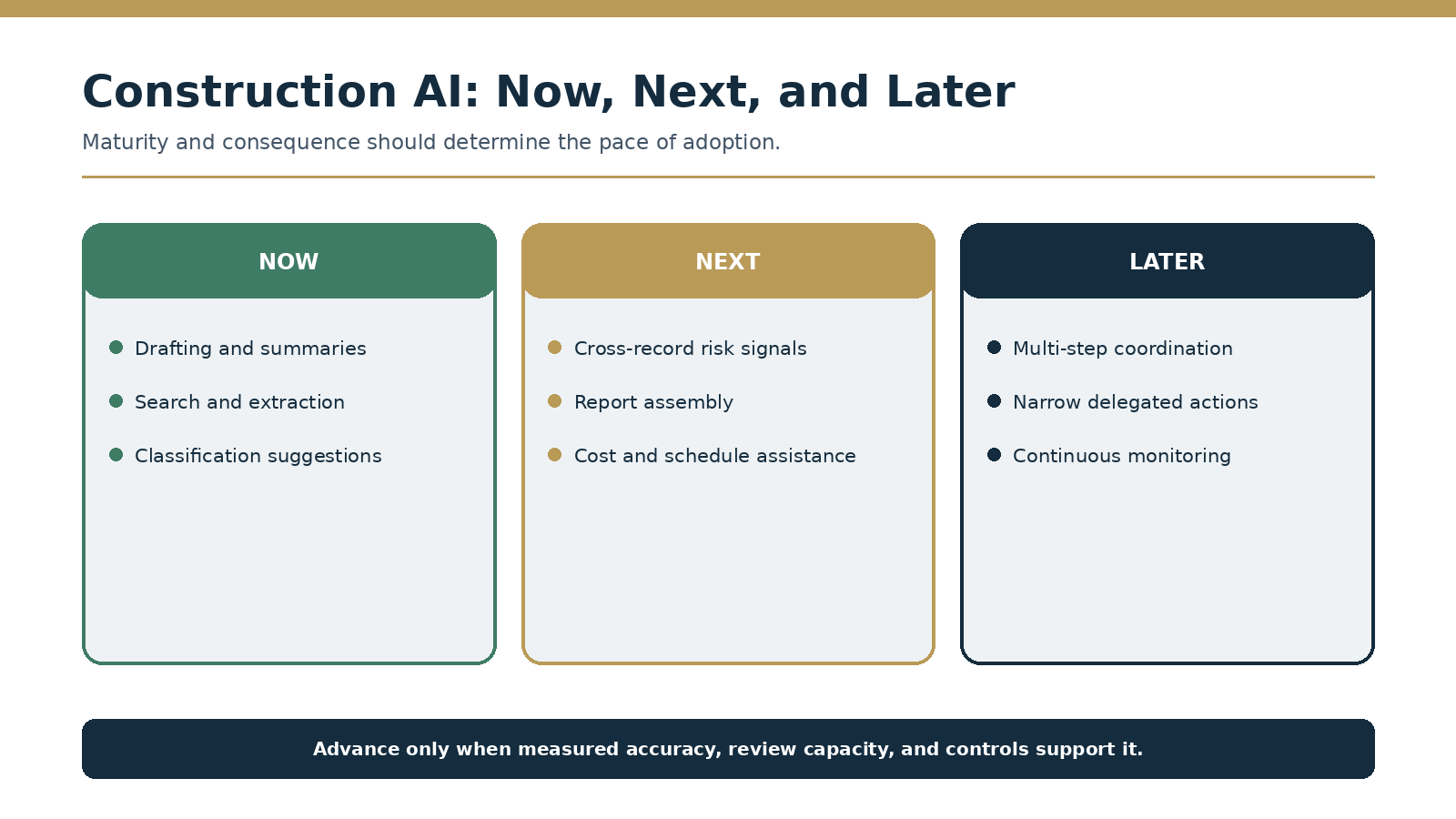
Construction AI is frequently discussed as if every application has the same maturity. It does not. Drafting a daily-report narrative from approved records is materially different from predicting a delay or approving a change order.
The useful way to evaluate a use case is to ask four questions: What information does it require? How objectively can the output be checked? What happens if it is wrong? What authority does it exercise?
Mature assistance: drafting and summarization
AI is most defensible when it prepares a draft from controlled information and a responsible person reviews the result.
Practical examples include:
- converting meeting transcripts into proposed minutes;
- summarizing daily reports into a weekly narrative;
- drafting an RFI from a field observation and referenced documents;
- preparing a first-pass submittal narrative;
- assembling executive-status commentary from approved cost and schedule data; and
- condensing long correspondence histories.
The principal risk is omission. A concise summary may remove a qualification, disagreement or unresolved assumption that matters commercially. The complete record must remain available.
Document extraction and project search
Plans and specifications contain information that is difficult to retrieve quickly. AI-assisted extraction can identify section titles, products, warranties, tests, submittal requirements and closeout obligations. Semantic search can help users find where an issue was discussed even when the same terminology was not used.
The limitation is interpretation. Scans, symbols, tables, addenda, cross-references and conflicting requirements can defeat extraction. A credible result should identify its source and distinguish an extracted statement from a professional conclusion.
Classification and routing
AI can suggest a project, record type, discipline, cost code, responsible team or priority. This is valuable because construction teams create thousands of records and inconsistent metadata weakens reporting.
However, silent miscoding compounds over time. A suggested cost code should include a correction path. High-confidence routine classifications may be automated only after performance is measured against a representative project sample.
Reporting and management briefs
AI can assemble narrative reporting around:
- work completed and work planned;
- open decisions and overdue responses;
- budget, commitment and forecast exceptions;
- schedule constraints and milestone exposure;
- safety and quality trends; and
- procurement items requiring attention.
The numbers must come from governed records. A language model should explain a calculated variance, not invent the metric.
Emerging risk signals
AI may help identify patterns that are difficult to see across disconnected workflows:
- repeated references to an unresolved condition;
- rising RFI age within a critical work package;
- change cost increasing without corresponding owner revenue;
- recurring inspection findings across floors or subcontractors;
- submittal approval dates threatening procurement; or
- general-conditions cost growing faster than schedule progress.
These are investigation signals, not findings of causation, responsibility or entitlement.
Schedule and cost assistance
AI may assist with schedule-activity drafting, logic review, constraint summaries, scenario narratives, cost-code suggestions, forecast explanations and reconciliation exceptions.
The weak point is input quality. An elegant delay prediction based on an incomplete schedule is less useful than a simple overdue-commitment report based on reliable records. Construction companies should prioritize the quality of the operating data before the sophistication of the model.
Computer vision
Photographs, video, drones and reality capture may support progress observation, site documentation and condition identification. The application is promising, but visibility, image quality, occlusion, changing site conditions and model coverage constrain the result.
Observed appearance is not proof of code compliance, completed scope or payment entitlement. Those conclusions often require contract interpretation, measurement and qualified inspection.
Controlled workflow coordination
The emerging high-value use case is coordination across records. A controlled agent could detect a field condition, prepare an RFI draft, identify reviewers, track the response date, connect possible cost and schedule exposure, and prepare follow-up. Consequential actions would remain behind explicit approval gates.
This is where an operating system matters. An isolated chatbot can draft. A connected construction environment can potentially maintain state, responsibility and evidence across the life of the issue.
How to prioritize use cases
Start with high-frequency tasks whose outputs are easy to verify and whose failure consequences are limited. Measure total cycle time, material correction rate, unsupported statements, review effort and user adoption. Expand only when measured performance is stable.
Do not begin with safety recommendations, contract interpretation, payment release or autonomous schedule changes. The apparent savings are outweighed by the authority and failure risk.
Syntecton’s role
Syntecton can frame AI use cases around work already occurring inside connected construction workflows. The strategic advantage is not the number of AI buttons. It is the ability to supply controlled context, place outputs inside the correct record and preserve human authority.