AI Construction Software: Evaluation Guide for Contractors
A procurement framework for evaluating construction AI software across data access, source evidence, permissions, workflow authority, security, and ROI.
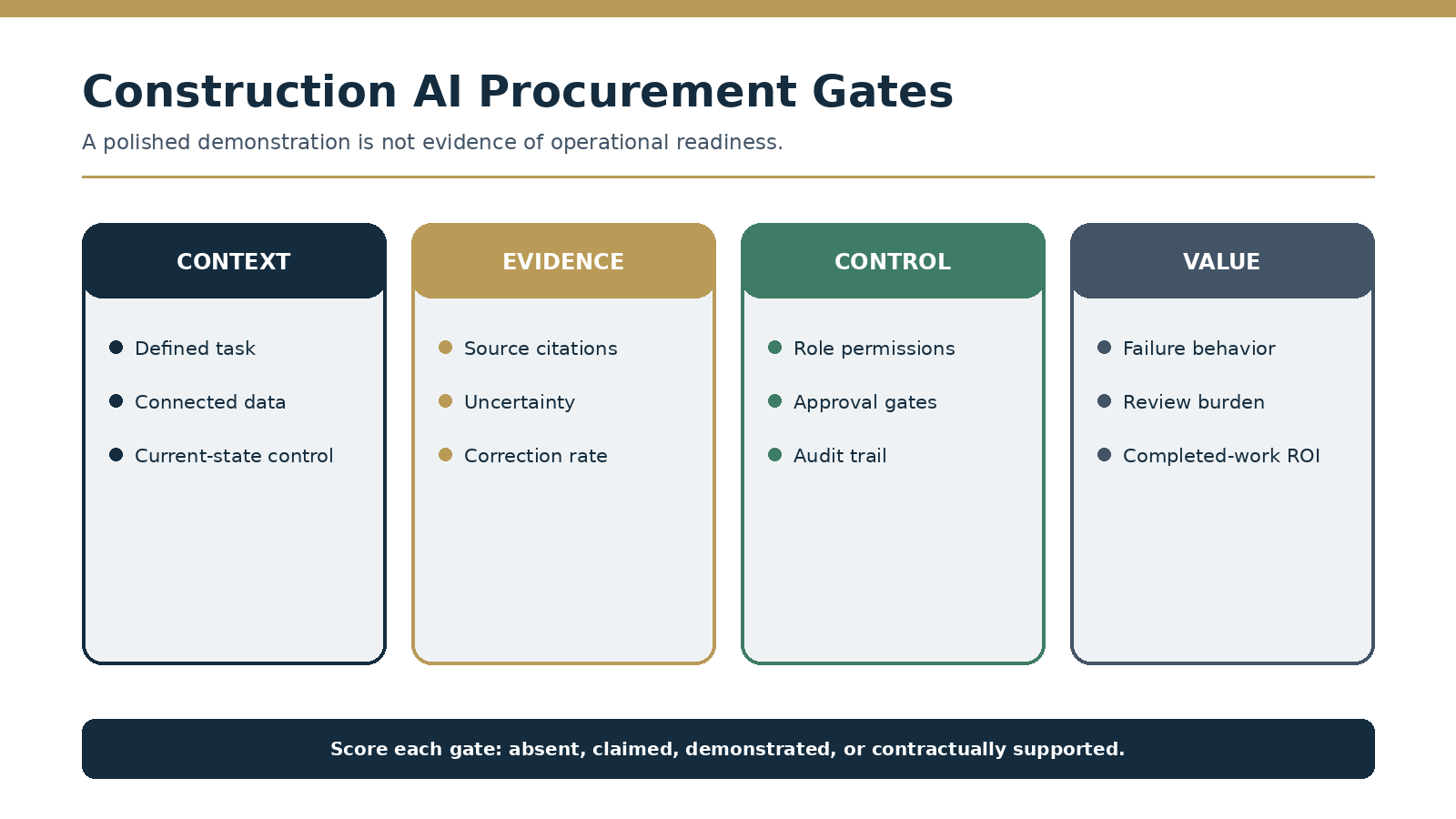
The construction software market is entering an “AI included” phase. That label provides almost no useful information to a buyer.
One product may rewrite a note. Another may search specifications. A third may analyze connected cost and schedule records. A fourth may act across workflows. These systems should not be procured under the same standard.
The right evaluation begins with the operating task, not the demonstration.
Define the job before evaluating the tool
A credible use case identifies:
- the existing task and responsible role;
- the information required;
- the output expected;
- the consequence of error;
- the required reviewer;
- the system of record;
- the authority, if any, delegated to AI; and
- the measurement baseline.
“Save project managers time” is not a defined use case. “Prepare a draft weekly status narrative from approved daily reports, open RFIs, submittals and current forecast data” is.
Data scope and context
Ask exactly what the AI can access. Can it work across project records or only within one screen? Does the user manually provide context? Can administrators exclude projects, companies or record types? Does the system understand relationships, or merely retrieve similar text?
If the product cannot distinguish a current drawing from a superseded revision, it is not ready for consequential document questions.
Evidence and accuracy
Every factual demonstration should be challenged:
- Does the answer cite its source?
- Can the user open the cited record or page?
- How does the system handle conflicting records?
- Does it state when evidence is insufficient?
- How is accuracy tested?
- What is the material correction rate?
- Can the customer test known failure cases?
Fluent output is not evidence of accuracy.
Permissions and confidentiality
AI must enforce access before retrieval, not merely hide the source after generating the answer. Test the product using different roles: project executive, subcontractor, architect, client and outside collaborator.
Ask whether customer prompts, outputs and documents are retained; whether they are used to train shared models; which subprocessors handle the data; where processing occurs; and how deletion works.
Contracts, pricing, claims strategy, employee information and protected project records should not be entered into public tools without approved terms and controls.
Workflow authority
Determine whether AI can only draft or whether it can send, change status, modify records, assign responsibility, approve, execute or release payment.
The vendor should demonstrate:
- role-based authority;
- mandatory approval gates;
- action logging;
- override and reversal;
- notification controls; and
- behavior when an integration or model fails.
An AI-generated change description is a drafting task. An AI-approved change order is a delegation of contractual authority.
Security and governance
Review model providers, subprocessors, independent assurance, incident notification, data segregation, encryption, administrative controls and the ability to disable AI by company, project or workflow.
Governance should also cover internal ownership. Someone must approve use cases, monitor incidents, review performance and retire unsafe workflows.
Measuring ROI honestly
AI ROI should be measured at the completed-work level:
Net benefit = avoided labor and failure cost − licensing − integration − governance − review − correction cost
Track time before and after, but also track:
- percentage of outputs accepted without material correction;
- unsupported-answer rate;
- review minutes;
- rework attributable to the output;
- user adoption;
- security or permission incidents; and
- operational outcome.
A vendor claim that a feature “saves hours” is weak unless it identifies the task, baseline, sample, review requirement and time period.
Red flags
Treat these as procurement warnings:
- answers without sources;
- broad access that bypasses project permissions;
- no distinction between current and superseded records;
- unclear customer-data training terms;
- autonomous action without narrow authority;
- performance measured only by generation speed;
- generic demonstrations using clean sample data; and
- product direction presented as current functionality.
Syntecton’s position
Syntecton should invite evaluation at the operating-system level: how records connect, how permissions apply, how workflow state is preserved and where authority sits. That is a harder standard than a polished chatbot demonstration, but it is the standard that matters in construction. For the governance model behind these questions, see AI in construction management.