AI for Construction Project Controls: Cost, Schedule & Risk
Understand how AI can support construction cost, schedule, progress and risk analysis—and why connected baselines and controlled data remain essential.
Project controls turn project data into management action. AI can accelerate that work, but it cannot replace the baselines, coding structures, update discipline and commercial judgment on which control depends.
The most useful role for AI is to surface exceptions and explain relationships earlier. It should not create the appearance of certainty where the underlying records are incomplete.
Cost intelligence
AI can assist with transaction classification, cost-code suggestions, variance narratives, commitment summaries, pending-cost detection and forecast explanations.
For example, it may identify that field reports repeatedly describe added work while no potential change is recorded, or that subcontract change exposure is increasing faster than corresponding owner recovery.
The signal should trigger reconciliation. It does not establish entitlement or the final forecast.
Schedule intelligence
AI may help draft activities from scope, inspect logic, identify missing constraints, summarize schedule updates and compare schedule narratives with recorded conditions.
A useful analysis still depends on calendars, relationships, durations, status dates, progress rules and field knowledge. If the schedule is not maintained, AI will produce sophisticated commentary on a weak model.
Progress measurement
AI can organize daily reports, photos, quantities and inspection records into a proposed view of progress. Computer vision may contribute observations from imagery.
Progress for payment or earned-value purposes requires defined rules. Visible installation does not automatically equal accepted, complete or billable work.
Risk signals across workflows
The strongest AI opportunity may be detecting combinations of evidence:
- an aging RFI affects a procurement release;
- the procurement release affects a critical activity;
- the field team references the same unresolved issue;
- a potential change lacks pricing;
- general conditions continue while recovery remains uncertain.
Traditional reports often show each fact separately. Connected intelligence can surface the chain.
Forecasting and predictive analytics
Predictive models may estimate outcomes based on historical patterns, but projects differ in delivery method, geography, team, scope and data quality. A probability is not a cause analysis.
Before trusting a forecast, ask:
- Is the training population relevant?
- Are definitions consistent?
- Is the current project data complete?
- How is uncertainty communicated?
- How often is the model recalibrated?
- Does a user understand the contributing evidence?
Management action
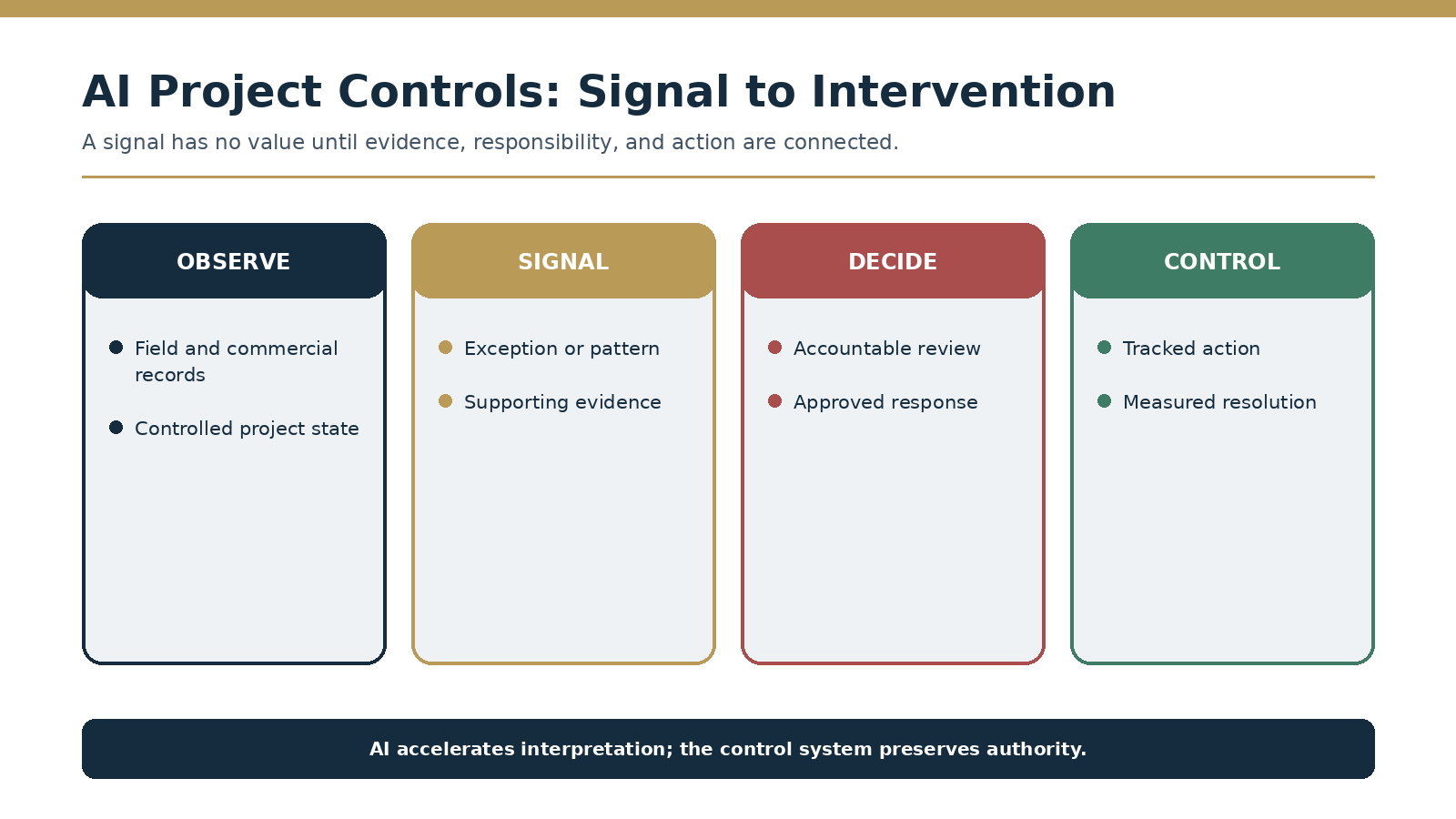
An AI signal creates value only when it enters a controlled response:
- detect the exception;
- display the supporting records;
- identify the responsible role;
- propose an action;
- obtain approval where required;
- track the commitment; and
- verify resolution.
Dashboards without responsibility create observation, not control.
Avoid duplicating the project-controls system
AI should not become a parallel set of invented metrics. Cost and schedule values should come from approved calculations and governed records. AI can summarize, connect and challenge those values.
This preserves one version of project state while allowing faster interpretation.
Syntecton’s role
Syntecton connects financial management, project controls, field execution and project records within one operating environment. That architecture can allow an AI signal to retain its evidence and move into accountable workflow.
The credible promise is earlier visibility and reduced administrative coordination—not automated certainty.