Construction Is Hiring While It Builds Less
Spending fell 3.8% year over year while contractors added 22,000 jobs in August. That gap is where margin goes to die - and why cash timing decides this year.
There is a number in the August jobs report that should stop anyone who runs a construction business, and it is not the headline. Construction employment rose by 22,000 in August. Meanwhile total construction spending in July ran 3.8% below where it was a year earlier. The industry is adding people while it puts less work in place. I have seen contractors do this before, and I know exactly what it is, because I have done it myself.
It is not confidence. It is fear of not being able to hire back.
The two lines are going opposite directions
Start with the spending. July 2026 came in at $2,157.6 billion at a seasonally adjusted annual rate — down 0.5% from June, and 3.8% below July 2025's $2,242.6 billion. That is not a wobble. It is the fifth month in a row without a meaningful up-move.
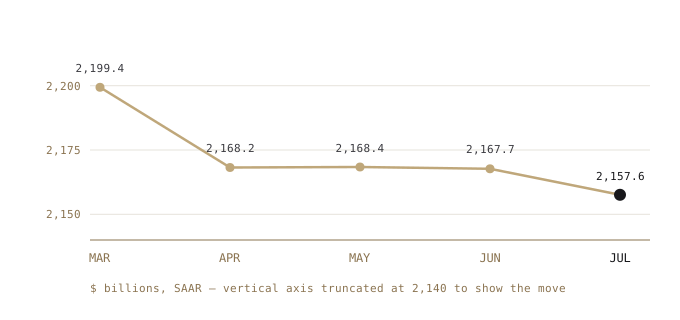
Now the headcount. Total nonfarm payrolls rose 162,000 in August with unemployment at 4.1%, and construction added 22,000 — with nonresidential specialty trade contractors up 8,000. Nonresidential specialty trades are the mechanical, electrical, drywall and finishes crews. Those are the people you hire when you expect to have work to give them.
Somebody is wrong. Either the spending data is understating what is being built, or contractors are carrying crews against work that has not been awarded yet.
What the composition tells you
The nonresidential picture explains most of it, and it is narrower than the headline suggests. Nonresidential spending technically rose 0.1% in July to $1.286 trillion, with private up 0.4% and public down 0.2%. But ABC's chief economist found the increase was entirely attributable to data centers — strip that category out and nonresidential spending fell for a second consecutive month, to its lowest level since September 2023.
So there are two markets. One is a small number of very large, very well-funded projects that are pulling in every available mechanical and electrical crew in their region at whatever rate it takes. The other is everything else, quietly shrinking.
If you are in the second market — a mid-sized general contractor doing schools, medical office, light industrial, tenant improvement — you are competing for labor at prices set by the first market while bidding against work priced by the second. That is the squeeze, and it doesn't show up as a lost job. It shows up as a won job with nothing left in it.
The leading indicator says don't expect relief soon. The AIA/Deltek Architecture Billings Index for July came in at 46.6, with design contracts at 47.2 — both below the 50 line — though project inquiries held at 52.6. Firms are being asked to quote. They are not being asked to draw. Inquiries without contracts is a pipeline of conversations, and you cannot staff a conversation.
Labor hoarding is a rational bet with an ugly failure mode
I want to be fair to the contractors adding headcount into a soft market, because the logic is sound. If you release a foreman with fourteen years on your jobs, you are not getting them back. The cost of rebuilding a crew when work returns is genuinely higher than the cost of carrying it thin for two or three quarters. Everyone who let people go in 2009 and spent 2014 through 2019 unable to staff a backlog learned that lesson expensively.
So you carry the crew. You take the marginal job at a thinner number to keep them busy. You tell yourself it is a bridge.
The failure mode is not that the bet is wrong. It is that carrying labor through a volume decline converts a margin problem into a cash problem, and it does it faster than most contractors' reporting can see. Payroll is weekly and certain. Revenue is monthly and conditional. Retainage is annual and optional. When you thin the margin and hold the overhead, the gap between money earned and money received stops being an accounting curiosity and becomes the entire question of whether you make it to the recovery you are staffing for.
Which is why the boring stuff is now the strategic stuff
Here is the part that sounds unglamorous and is not. In a market like this, the highest-return work available to most contractors is not winning another bid. It is collecting what they have already earned.
Look at the actual balances. Retainage on your open contracts. Pending change orders that have been performed but not priced. Pay applications sitting in review because a lien waiver from a second-tier supplier never arrived. Closeouts on jobs that reached substantial completion two quarters ago and are still not releasable because nobody can assemble the document package.
None of that requires a bid. None of it requires a market recovery. All of it is money you have already spent labor to earn, sitting in someone else's account, and in a year with 3.8% less work to go around it is the cheapest capital available to you.
The reason it goes uncollected is almost never a dispute. It is that the evidence is scattered — the change order is in one system, the field record that proves it is in another, the waiver is in an email, the substantial completion date is on a PDF — and no one can answer, in one place, the only question that matters: what is owed, what condition is blocking it, and who has the document. That is the actual argument for running the operation on a single connected system rather than a stack of tools that each hold one piece of the answer. Not efficiency. Collectability.
What I would do this quarter
Three things, in order.
Age your retainage like a receivable. Not the balance — the conditions. Per contract: what is outstanding, who owes it, what date it should have released. Most contractors discover a job that has been releasable for months.
Price the marginal job against cash, not margin. A 3% job that pays in 45 days is a better business than a 6% job that pays in 120 with 10% held for a year. If your estimating conversation doesn't include payment terms, it is only half a conversation.
Decide the labor bet explicitly, with a number and a date. "We will carry four more crews than the backlog supports through Q1, and it will cost approximately X" is a strategy. Carrying them because nobody wanted to make the call is how a rational bet becomes an accident.
The recovery may well come. Inquiries at 52.6 is not nothing. But it is going to arrive for the contractors who still have the cash to staff it, and right now a meaningful share of that cash is not in the market — it is sitting in retainage accounts, waiting on paperwork nobody has gotten around to assembling.
Sources
- Total construction spending, July 2026, $2,157.6B SAAR, down 0.5% from June and 3.8% below July 2025's $2,242.6B — source
- Monthly total construction spending, March through July 2026 — source
- Construction employment rose 22,000 in August 2026; nonresidential specialty trade contractors up 8,000; total nonfarm payrolls up 162,000; unemployment 4.1% — source
- Nonresidential construction spending rose 0.1% in July 2026 to $1.286 trillion SAAR; private nonresidential up 0.4%, public down 0.2%; excluding data centers, spending fell for a second straight month to the lowest level since September 2023 — source
- AIA/Deltek Architecture Billings Index for July 2026 was 46.6, with project inquiries at 52.6 and design contracts at 47.2, released August 19, 2026 — source