How Retainage Works in Construction — and How to Get It Back Faster
Retainage is 5-10% of every progress payment, held until closeout. How it works, what your state now caps it at, and how to shorten the wait for release.
Retainage is the only line on a pay application that is subtracted from money you have already earned. You did the work, the owner agreed you did the work, the architect certified you did the work — and then five or ten percent of it stays in someone else's account for a year. Every contractor understands the mechanic. Far fewer track what it actually costs them, and fewer still know that the rules governing it changed in a material way in 2026.
What retainage actually is
Retainage (called "retention" in some regions and in most California contracts) is a percentage withheld from each progress payment and held until the work is complete. It exists to give the party paying you leverage: a pot of your money large enough that you will come back and finish the punch list, produce the as-builts, and honor the warranty.
Retainage typically ranges from 5% to 10% of each progress payment, most commonly withheld at exactly one of those two figures. It is not a penalty, not a deposit, and not a claim against your work. It is a withholding, and it flows downhill: an owner retains from the general contractor, and the general contractor retains from every subcontractor, often at the same percentage and often on the same clock.
That last point is the one that hurts. Retainage is commonly withheld until the project is complete, not until your scope is complete. The site contractor who finished in month two of an eighteen-month job waits sixteen months for money earned before the slab was poured.
The percentage isn't the number that matters
Contractors argue about 5% versus 10%. The more useful comparison is retainage against net profit, because that is the ratio that decides whether you can bond the next job.
Take a $2.4M contract. At 10%, $240,000 is withheld across the life of the job. If your net margin on that contract is 4% — $96,000 — then the owner is holding two and a half times your entire profit on the project, and holding it after you have already paid your suppliers, your subs, and your crew out of pocket. You financed the job, and the return on it sits in escrow.
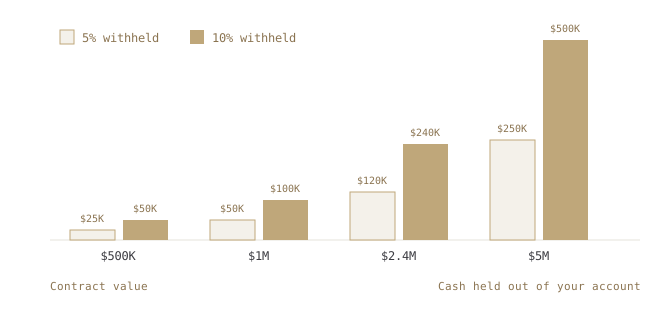
Run the same arithmetic on your own backlog. Add up every open contract, multiply by your retainage percentage, and put the total next to the limit on your line of credit. Whichever way that comparison lands for you, it reframes the problem correctly: retainage is an unsecured, interest-free loan you make to your customer, and it deserves to be measured against the credit facility you pay a bank for.
Your state may have already changed the rules
Retainage is governed by state statute, and the statutes are not converging. Some states cap it, some stay silent and let the contract control, one prohibits it outright, and one of the largest construction markets in the country changed its law with effect from the first day of 2026.
| Jurisdiction | Cap | Applies to | Note |
|---|---|---|---|
| California | 5% | Private works, contracts entered into on or after Jan 1, 2026 | SB 61 — binds owners, direct contractors and subs of any tier |
| Federal | 10% maximum | Fixed-price construction contracts | FAR 52.232-5(e) — only "until satisfactory progress is achieved" |
| Texas | 10% | Private projects | Statutory retainage requirement, per Levelset |
| New Mexico | Prohibited | — | Withholding retainage is not permitted |
The California change is worth understanding in detail even if you never build there, because it is the template other states copy. SB 61 was signed on July 14, 2025 and created Civil Code section 8811. It caps retention on private works at 5% of any progress payment, and caps the aggregate held at 5% of the contract price. It applies prospectively — contracts executed before January 1, 2026 are not subject to it — which means for the next several years California contractors will be running two portfolios under two different retention regimes at the same time.
There are carve-outs. Residential projects of four stories or fewer are exempt, and the cap does not protect a subcontractor who was asked in writing for performance and payment bonds before bidding and failed to provide them. And there is a real enforcement lever: courts must award attorney's fees to the prevailing party in a dispute over compliance. A statute with fee-shifting is a statute that gets used.
The operational point: your retainage percentage is a contract term, but the ceiling on that term is a question of statute, project type, execution date, and whether the job is public or private. If your accounting system carries one retainage rate per customer, it is already wrong.
The federal clock runs differently
Federal work is the clearest illustration that retainage is supposed to be temporary and conditional, not automatic. FAR 52.232-5(e) permits the contracting officer to retain "a maximum of 10 percent of the amount of the payment until satisfactory progress is achieved" — the retention is tied to performance, not to the calendar. When the work becomes substantially complete, the contracting officer retains only "that amount the Contracting Officer considers adequate for protection of the Government" and releases the rest.
The clause also requires full payment without retainage on completion and acceptance of each separately priced building or division of the contract. If your contract prices phases separately, retainage on a finished phase should be released when that phase is accepted.
Most private contracts contain no such mechanism unless you negotiate one in. That is the gap worth closing at contract review, not at closeout.
When retainage is supposed to be released
Retainage release hangs off substantial completion, not final completion, and the document that fixes the date is usually AIA G704. That certificate records the date of substantial completion, attaches the list of items to be completed or corrected, sets the time allowed to finish them, and establishes who carries maintenance, heat, utilities and insurance from that point forward.
It also starts the warranty. Under G704, "warranties required by the Contract Documents shall commence on the date of Substantial Completion of the Work" unless a different date is stated for a particular warranty. So the same signature that should begin the release of your money also begins the year in which you are obligated to come back and fix things. Contractors who let the substantial completion date drift because the punch list isn't finished are trading a later warranty expiration for a later payment — and it is almost never a good trade, because the payment delay is certain and the warranty risk is probabilistic.
Two things should happen at substantial completion in a well-drafted contract: retainage steps down to a lower percentage, and the remaining balance is scheduled against completion of the punch list and delivery of closeout documents. Two things happen in a badly drafted contract: nothing, and nothing. Since the prevailing range is 5% to 10%, a step-down written from the top of that range to the bottom at substantial completion is the version worth asking for.
Why release actually stalls
In practice, retainage does not sit unpaid because someone decided not to pay it. It sits unpaid because a required condition cannot be evidenced. Ranked by how often they are the actual blocker:
- A missing or defective lien waiver somewhere down the subcontractor chain. Final payment is almost always conditioned on unconditional final waivers from every tier, and one absent waiver from a second-tier supplier holds the whole release.
- Closeout documents not delivered — O&M manuals, as-builts, warranties, training records, attic stock. These are usually a contractual condition of final payment and are usually chased by email three months after the crew demobilized.
- Punch list items with no agreed completion date. G704 asks for the time allowed for correction precisely because an open-ended punch list is an open-ended withholding.
- An unresolved change order. If a pending change order is in dispute, the disputed amount often freezes the entire final payment rather than just the amount in question.
- No one owns the release. The project manager moved to the next job, the accounting team doesn't know the substantial completion date, and the file sits.
Notice that four of the five are documentation failures, not payment disputes. That is the good news, because documentation failures are the kind you can engineer out.
How to get it back faster
Negotiate the step-down before you sign. The single highest-leverage retainage term is not the percentage — it is a written reduction at a defined milestone. Retainage reducing from 10% to 5% at 50% completion, and to zero on substantial completion for all scopes with no open punch items, is a standard ask and is frequently granted because it costs the owner nothing while the work is going well.
Ask for early release of completed scopes. Federal contracts already require it for separately priced divisions. On private work, the argument is straightforward: the excavation subcontractor's exposure ended fourteen months ago, and holding their retainage does not protect the owner from anything.
Set the substantial completion date deliberately. Prepare your own punch list, submit it, and request the certificate. Do not wait to be inspected into it. The date is the trigger for retainage step-down, warranty start, insurance transfer, and in most contracts the end of liquidated damages exposure — it is worth managing as a milestone with an owner, not treating as an outcome.
Assemble closeout continuously, not at closeout. Every O&M manual, warranty certificate and as-built markup that exists on the day of substantial completion is a day removed from the wait. Collecting them at the end, from subcontractors who have already been paid 95% and have moved on, is the hardest collection problem in the business.
Track retainage as a receivable with a date, not as a percentage on an invoice. Most contractors can tell you their retainage balance. Far fewer can tell you, per contract, what condition is outstanding, who owes the document, and what the release date should be. The balance is the symptom; the conditions are the thing you can act on.
The tracking problem
Retainage is where the ordinary way of running a construction business breaks down most visibly. The percentage lives in the contract. The withheld amount accrues on the pay application. The release condition is a lien waiver held by a subcontractor's bookkeeper. The trigger is a date on a certificate signed by an architect. The deadline is set by a state statute that may have changed since you signed. Five systems, five owners, no single view.
The consequence is not that anyone loses the money. It is that nobody can see it coming due — so it is never chased on the day it becomes chaseable, and a receivable you earned two years ago quietly becomes a receivable you negotiate.
That is worth sitting with, especially in a market where the volume is thinner than it was. Total construction spending in July 2026 ran at $2,157.6 billion at a seasonally adjusted annual rate, 3.8% below a year earlier. When there is less work to bid, the cash already earned and already sitting in someone else's account stops being an accounting footnote and starts being the difference between bonding the next job and watching it go to someone who could.
Sources
- Retainage typically ranges from 5-10% of each progress payment — source
- California SB 61 caps retention on private works at 5%, effective for contracts entered into on or after January 1, 2026 — source
- California SB 61 signed July 14, 2025; creates Civil Code section 8811; applies to owners, direct contractors and subcontractors of any tier — source
- FAR 52.232-5(e) permits the contracting officer to retain a maximum of 10 percent until satisfactory progress is achieved, and to release withheld funds on substantial completion — source
- AIA G704-2017 records the date of substantial completion; warranties commence on that date — source
- Total construction spending, July 2026, $2,157.6B SAAR, down 3.8% year over year — source
- Texas requires 10% retainage on private projects; New Mexico prohibits withholding retainage — source