Construction Electronic Signatures and Approval Workflows
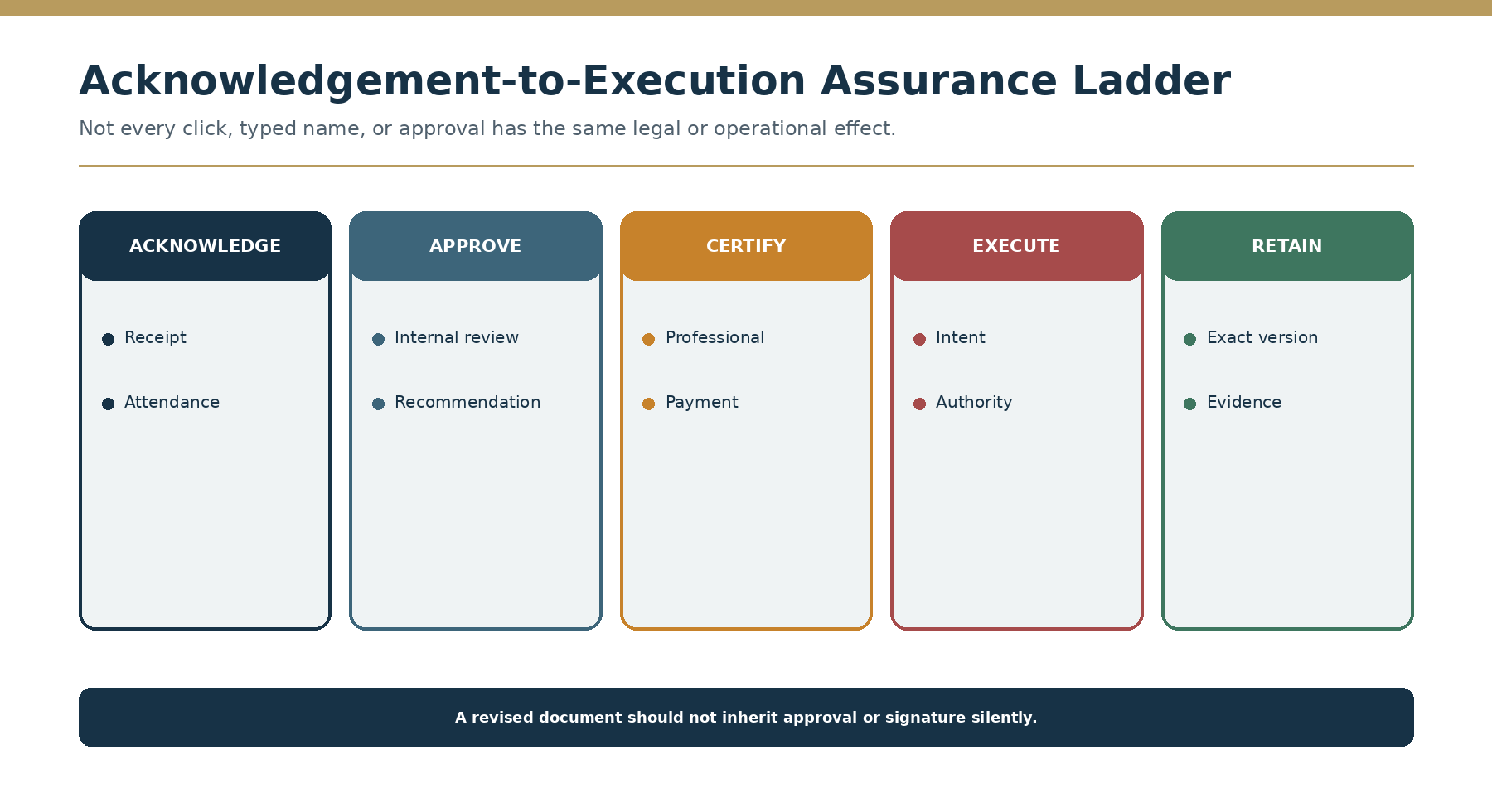
Distinguish construction acknowledgements, internal approvals, certifications, electronic signatures, execution, document versions, authority.
Construction teams often collapse several different actions into “signed”:
- workflow acknowledgement;
- internal approval;
- professional certification;
- contractual execution;
- electronic signature;
- digital signature; and
- notarization.
Those actions have different purposes and legal effects.
Determine the required assurance
The record, agreement, transaction, law, jurisdiction, and company policy determine what is required. A toolbox-talk acknowledgement does not need the same assurance as a prime-contract modification or lien document.
Do not use a typed name in a comment to silently execute a major commercial transaction.
Exact document version
The signer must be associated with the exact document version. If scope, price, date, exhibits, or terms change after approval, the system should invalidate or restart the required approval or signature process.
Approval of a draft should not migrate automatically to a revised document.
Signature evidence
A controlled workflow should preserve:
- signer identity;
- organization and acting capacity;
- authority;
- intent;
- exact document version;
- authentication method;
- date, time, and time zone;
- consent or required disclosure;
- completion evidence;
- refusal or failure;
- alteration detection where supported; and
- final retained copy.
Do not claim digital-signature cryptography, tamper-proofing, or legal enforceability unless those functions and the applicable implementation have been verified.
Approval versus execution
An internal reviewer may approve content for transmission without authority to bind the company. A project manager may recommend payment while a different person authorizes release.
The workflow should show review, internal approval, external signature, full execution, effective date, and downstream update separately.
Failed and incomplete signatures
Track declined signatures, expired requests, failed authentication, changed documents, missing parties, and superseded envelopes. A document is not executed merely because one required person signed it.
Syntecton’s role
Syntecton’s Signature and Review capabilities can be positioned around controlled review, exact document version, signer evidence, workflow status, and retained record—subject to verification of the live implementation.
The promise is disciplined execution, not universal enforceability.
Signature workflow checklist
- Verify signers, signing order, capacity, and authority.
- Present the complete document and incorporated exhibits.
- Bind approval to the exact version.
- Record authentication, intent, date, and time.
- Preserve refusal, expiration, and failed delivery.
- Restart approval after material revision.
- Retain the final copy and supporting evidence.
- Trigger downstream action only after required execution.
If an owner approves internally and the contractor later revises an exhibit, the earlier approval must not remain attached silently. Version integrity matters more than the visual appearance of a signature.