The Construction Closeout Checklist That Actually Releases Your Money
A closeout checklist organized by what each item unlocks - retainage release, warranty start, liquidated damages - with the substantial completion clock mapped out.
Every closeout checklist on the internet is the same list: punch list, as-builts, O&M manuals, warranties, final lien waivers, certificate of occupancy. The list is not wrong. It is just useless in the form it is usually given, because it is sorted by document type instead of by consequence — and closeout is not a filing exercise. It is the last and slowest payment event on the job, and the reason it takes six months instead of six weeks is almost never that someone couldn't find a warranty certificate.
Closeout is a payment process wearing a punch list costume
Consider what is actually at stake when a job reaches the end. Retainage — typically 5% to 10% of every progress payment you have submitted — is sitting in the owner's account. Your warranty obligation has either started or hasn't. Your liquidated damages exposure has either stopped running or hasn't. Your insurance and utility obligations either transferred or didn't. Your subcontractors are waiting on their own retainage, which you cannot release until you can evidence that they released their lien rights.
All of that turns on a single event with a single date, and most contractors treat that event as something that happens to them rather than something they schedule.
The one date everything hangs on
Substantial completion is the hinge. Not final completion — substantial completion. Under AIA G704-2017, the certificate records the date of substantial completion of the work or a designated portion of it, attaches the architect-verified list of items to be completed or corrected, fixes the time allowed for completing them, states the date the owner will occupy, and describes who carries maintenance, heat, utilities and insurance from that moment.
And it starts the clock you own: "warranties required by the Contract Documents shall commence on the date of Substantial Completion of the Work," unless the contract names a different date for a specific warranty.
On federal work the payment consequence is explicit. FAR 52.232-5(e) directs that when the work is substantially complete, the contracting officer retains only "that amount the Contracting Officer considers adequate for protection of the Government" and releases the remainder. It also requires payment in full, without retainage, on completion and acceptance of each separately priced building, public work or division of the contract.
Private contracts usually mirror the structure — retainage steps down at substantial completion, the remainder releases at final — but only if someone negotiated it in. Read your contract before you read the rest of this checklist. If there is no defined retainage step-down at substantial completion, the date buys you a warranty start and an insurance transfer and gives you nothing in return.
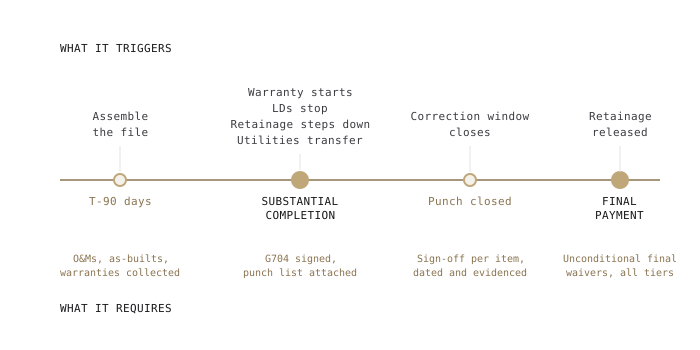
The checklist, sorted by what it unlocks
Ninety days out — while you still have leverage
This is the only phase of closeout where you hold something your subcontractors want: their remaining progress payments. Everything you fail to collect here, you will chase for free later.
- Warranty certificates from every subcontractor and supplier, with start dates left open pending the substantial completion date. Collect them as a condition of the pay application, not as a closeout request.
- O&M manuals and equipment data, indexed to the specification section they satisfy — the owner's rep will reject a box of PDFs and accept an index.
- As-built markups current to the field, not reconstructed from memory in month twenty.
- Training and demonstration scheduled, with dates on the owner's calendar. Training is the most commonly forgotten condition of final payment and the hardest to arrange once crews demobilize.
- Attic stock and spare parts delivered and receipted. A signed receipt is the entire deliverable; produce it now.
- Your own pre-punch walk completed, so the architect's list is short and you are not discovering scope during the inspection that sets your correction deadline.
At substantial completion — the date you should be asking for
- Request the inspection in writing. Do not wait to be scheduled into it. The certificate is your trigger for retainage step-down and the end of liquidated damages exposure in most contracts; every week of drift is a week of your money.
- Submit your own punch list with the request. Under G704 the contractor prepares the list and the architect verifies and amends it. Submitting first sets the frame.
- Get the correction period stated on the certificate. An open-ended punch list is an open-ended withholding, and G704 asks for the time allowed precisely so it isn't open-ended.
- Confirm the occupancy date and the transfer of maintenance, heat, utilities and insurance in writing. These are on the form. Leaving them blank means you are still paying for a building someone else is using.
- Certificate of occupancy, or a temporary CO with the conditions listed. Note which authority issued it and what remains outstanding.
- Notify your surety and your insurer of the date. Both price risk off it.
During the correction period — evidence, not effort
- Close each punch item individually with a date and a photograph, signed off by the party who raised it. A punch list closed "in bulk" at the end is a punch list the owner can reopen.
- Resolve every pending change order. A disputed change order commonly freezes the whole final payment, not just the disputed amount. Settle it, or carve it out in writing as a preserved claim so the rest can release.
- Collect conditional final lien waivers from every tier, and confirm the second- and third-tier suppliers your subcontractors used. One missing waiver from a supplier you never contracted with will hold your entire release.
At final completion — the release package
- Unconditional final waivers, all tiers, matched to the final payment amount.
- Consent of surety to final payment, where a bond is in place.
- Final certified payroll and any prevailing wage documentation on public work.
- The complete record set: as-builts, approved submittals, RFI log, test and balance reports, commissioning records, inspection reports.
- A written request for release of retainage that states the substantial completion date, the correction completion date, and lists each contractual condition with the document that satisfies it.
That last item is the one nobody does, and it is the one that works. Most retainage does not sit unpaid because of a dispute. It sits unpaid because the person who has to approve it cannot tell, from what you sent, that every condition has been met. Make it impossible to be unsure.
Why closeout gets more expensive in a thinner market
Closeout has always been the part of the job that runs on goodwill and leftover attention. That is a workable arrangement when the next job is already funded and the team is rolling straight onto it. It is a much worse arrangement now.
Total construction spending in July 2026 ran at $2,157.6 billion at a seasonally adjusted annual rate, 3.8% below the same month a year earlier. Nonresidential spending technically rose 0.1% to $1.286 trillion, but ABC's analysis found the increase was entirely attributable to data centers — excluding that category, nonresidential spending fell for a second straight month, to its lowest level since September 2023.
When new volume thins, the cash you have already earned stops being a back-office concern. A retainage balance that used to be a rounding error against next quarter's billings becomes the working capital that carries the company. And the rules are moving too: California's SB 61 capped private-works retention at 5% for contracts entered into on or after January 1, 2026, which means contractors there are now closing out two portfolios under two different retention regimes — one signed before the cutover, one after.
Build the file, not the binder
The reason closeout takes months is structural. The punch list lives in a field app. The as-builts live with the superintendent. The warranties live in an email folder. The lien waivers live in accounting. The substantial completion date lives on a signed PDF that three of those four groups have never seen. Nobody is withholding anything; the evidence is simply scattered across systems that were never designed to answer one question together: is this job releasable, and if not, what exactly is missing?
A checklist doesn't fix that. What fixes it is treating the closeout file as something that accumulates continuously from the first submittal — every warranty, waiver, sign-off and as-built landing in the project record when it is created, attached to the obligation it satisfies, so that on the day the certificate is signed the package is already assembled.
The test is simple, and you can run it on your oldest open job this afternoon. Ask for the outstanding conditions on its retainage release. If the answer takes more than an hour to produce, the closeout is not slow because of the punch list.
Sources
- AIA G704-2017 records the date of substantial completion, attaches the list of items to be completed or corrected, and sets the time allowed for correction, occupancy date and responsibility for maintenance, heat, utilities and insurance — source
- Under G704-2017, warranties required by the Contract Documents commence on the date of Substantial Completion — source
- FAR 52.232-5(e) requires release of withheld funds on substantial completion beyond the amount the contracting officer considers adequate for protection of the Government, and full payment without retainage on acceptance of each separately priced division — source
- Retainage typically ranges from 5-10% of each progress payment — source
- California SB 61 caps private-works retention at 5% for contracts entered into on or after January 1, 2026 — source
- Total construction spending, July 2026, $2,157.6B SAAR, down 3.8% year over year — source
- Nonresidential construction spending rose 0.1% in July 2026 to $1.286 trillion SAAR; excluding data centers it fell for a second straight month to the lowest level since September 2023 — source