Construction Audit Trails: Project History and Accountability
Understand what a construction audit trail should record across identity, versions, approvals, permissions, notifications, signatures, exports, and actions.
Many construction applications call a chronological activity feed an audit trail. “Alex updated the record” is not enough for a serious operational review.
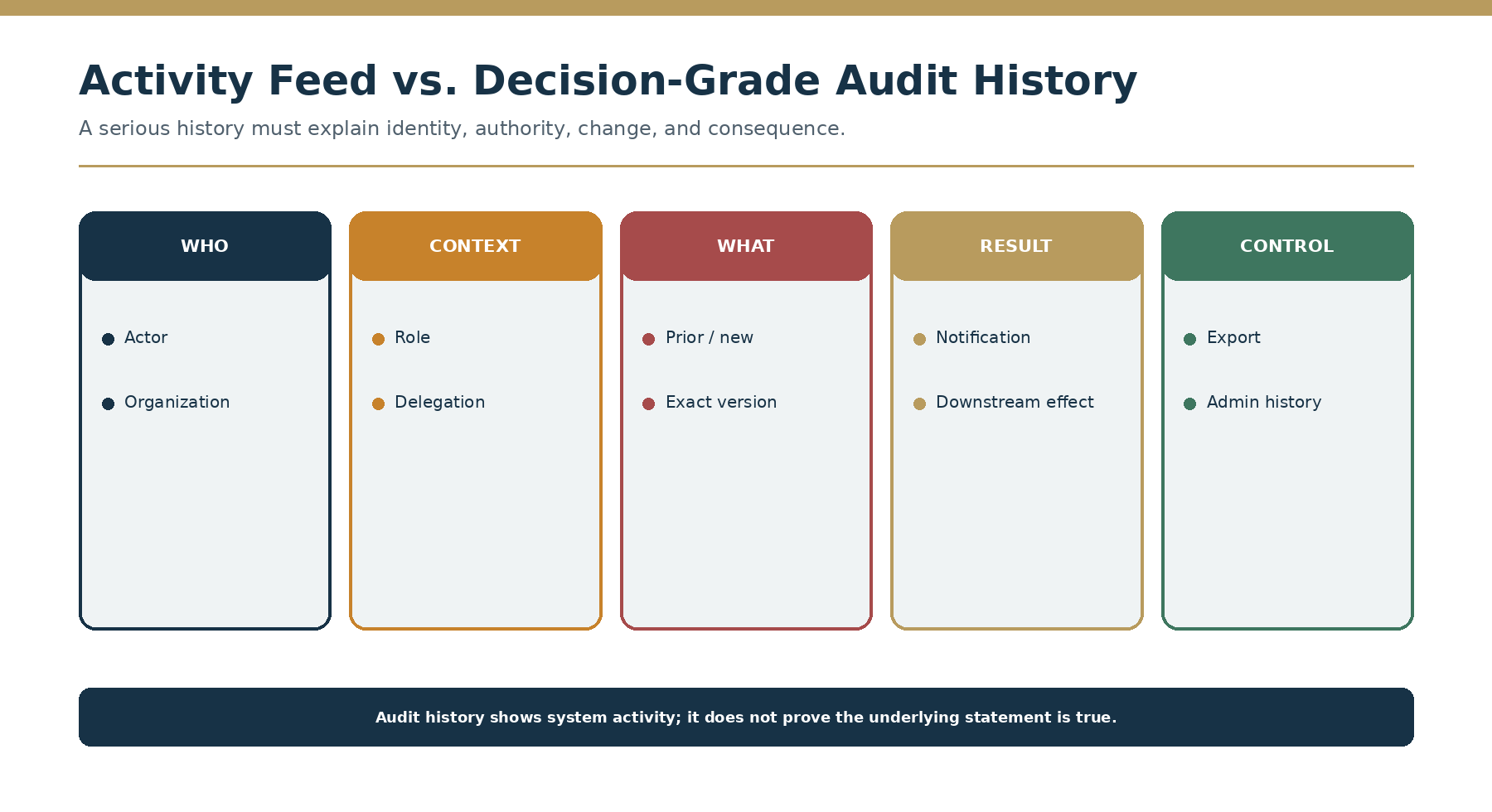
A useful audit history must explain what changed, from what to what, under which identity and role, against which record version, through what authority, and with what downstream consequence.
Document history versus event history
Document history includes original file, revisions, status, publication, supersession, signatures, retention, and integrity information where supported.
Event history includes creation, access, edit, submission, response, decision, notification, acknowledgement, export, permission change, deletion request, restoration, and integration activity.
A version list may show that files existed. It may not show which version was officially published, who could publish it, whether recipients were notified, or whether a metadata edit changed the apparent authority of the record.
Minimum audit event
A decision-grade event should capture:
- unique event identifier;
- actor identity and organization;
- acting role;
- timestamp and time zone;
- record identifier and version;
- action performed;
- prior and new state;
- reason or comment;
- authority or delegation context;
- source channel;
- notification result;
- linked downstream action; and
- export, deletion, or restoration context where applicable.
Security-log guidance such as NIST SP 800-92 is not a construction evidence standard, but it reinforces the need for organized log management across systems.
Authority context matters
The same action has different meaning depending on authority. A subcontractor can submit a change proposal without authority to approve the owner change. A superintendent can document an instruction without authority to execute a contract modification.
An audit history should record not only the role label but the permission and delegation under which the action occurred.
Downstream effects
Project decisions rarely remain within one record. An approved change may affect the prime contract, subcontract, budget, forecast, schedule, schedule of values, billing, and reporting.
The audit should show whether those transitions succeeded, failed, were reversed, or remained incomplete.
Authentication is not truth
Federal Rule of Evidence 901 generally requires evidence sufficient to support a finding that an item is what the proponent claims. Rule 902 includes certification routes for certain electronic records and copied data. Those rules do not make the underlying content accurate, relevant, non-hearsay, or persuasive.
Keep the distinctions clear:
Authenticated record ≠ admissible record ≠ persuasive record ≠ true statement
Software should preserve technical and operational context. Counsel determines its legal use.
Administrative risk
Audit architecture should also capture permission escalation, role changes, administrative edits, exports, deletion attempts, restoration, and integration failures. A project-level history that excludes administrator activity leaves a major blind spot.
Do not describe an audit log as immutable or tamper-proof unless the technical model, administrator boundaries, backup process, and export controls have been verified.
Syntecton’s role
Syntecton can position audit history as an operating control connected to permissions, workflow state, approvals, records, and downstream transactions—not merely a list of clicks.
The commercial promise should remain “traceable project history,” not guaranteed admissibility or forensic proof.
Audit-quality review
Confirm that the reviewer can identify the exact record and version, prior and new state, actor and organization, acting role, authority, notification result, related downstream action, administrative activity, and export context.
An audit trail is weakened when it records only successful actions, relies on editable narrative, omits administrators, loses time-zone context, overwrites versions, or records approval without the content approved.
Failed delivery, rejected signature, denied access, incomplete integration, attempted self-approval, restoration, and reopening may explain the history as much as completed actions.