Construction AI Risk Management and Governance Guide
A practical governance framework for managing hallucination, permissions, confidentiality, bias, cybersecurity, automation risk, and human review
AI risk in construction is not primarily a theoretical ethics discussion. It is an operating-control problem.
An unsupported contract summary can affect a commercial decision. A stale drawing citation can direct the wrong work. A permission leak can expose subcontractor pricing or claims strategy. An automated classification error can distort financial reporting. The required control depends on what the AI is allowed to influence.
Adapt the NIST structure
NIST’s voluntary AI Risk Management Framework uses four core functions: Govern, Map, Measure and Manage.
For a contractor, that translates into:
- Govern: establish approved tools, prohibited information, authority, ownership, retention and incident policy.
- Map: define the use case, affected stakeholders, required data and consequence of failure.
- Measure: test accuracy, unsupported answers, permission behavior, correction rates and operational outcomes.
- Manage: apply controls, monitor performance, respond to incidents and restrict or retire unsafe uses.
Hallucination and unsupported content
Generative AI can produce plausible statements that are not supported by project records.
Controls should include source requirements, retrieval from approved project context, visible uncertainty, qualified review and testing against known failure cases. Where no adequate source exists, the correct response is “insufficient evidence,” not a completed-looking answer.
Stale information
Construction records change authority over time. Drawings are superseded, submittals are revised, changes are rejected and responses are clarified.
The AI layer must understand publication and revision status. Historical information can remain searchable, but it should not be presented as current direction.
Permission leakage
An AI system can reveal restricted data through a summary even when the underlying file remains inaccessible. Permissions must be applied before retrieval and generation.
Organizations should test cross-role scenarios and log the records retrieved for each response. External users deserve particular scrutiny because project platforms often contain owner, contractor and subcontractor information under different access rules.
Confidentiality and data use
Before deployment, review:
- whether customer content trains shared models;
- prompt and output retention;
- processing location;
- subprocessors;
- deletion and export;
- incident notification; and
- contractual allocation of data risk.
Public tools should not receive confidential contracts, pricing, claims analysis, personal information or protected project data outside an approved policy.
Bias and people-related decisions
AI-supported vendor scoring, workforce analysis and safety enforcement may reproduce biased criteria or historical patterns. Preserve defined evaluation factors, consistency testing, human accountability and an appeal path.
AI should not become an unreviewable mechanism for determining who receives work, discipline or adverse treatment.
Automation bias
Users may trust generated output because it is fast, well written and embedded in the software. Labels alone are insufficient. The interface should show sources, distinguish suggestions from approved records and require deliberate approval for consequential actions.
Human review must be designed
A workable review control identifies:
- the qualified reviewer;
- the evidence displayed;
- required verification;
- mandatory versus optional review;
- the approval record;
- whether action is blocked before approval; and
- correction and escalation procedures.
Review capacity must also be considered. If AI increases output volume beyond the ability of qualified staff to verify it, the human-in-the-loop control fails.
Consequence-based control
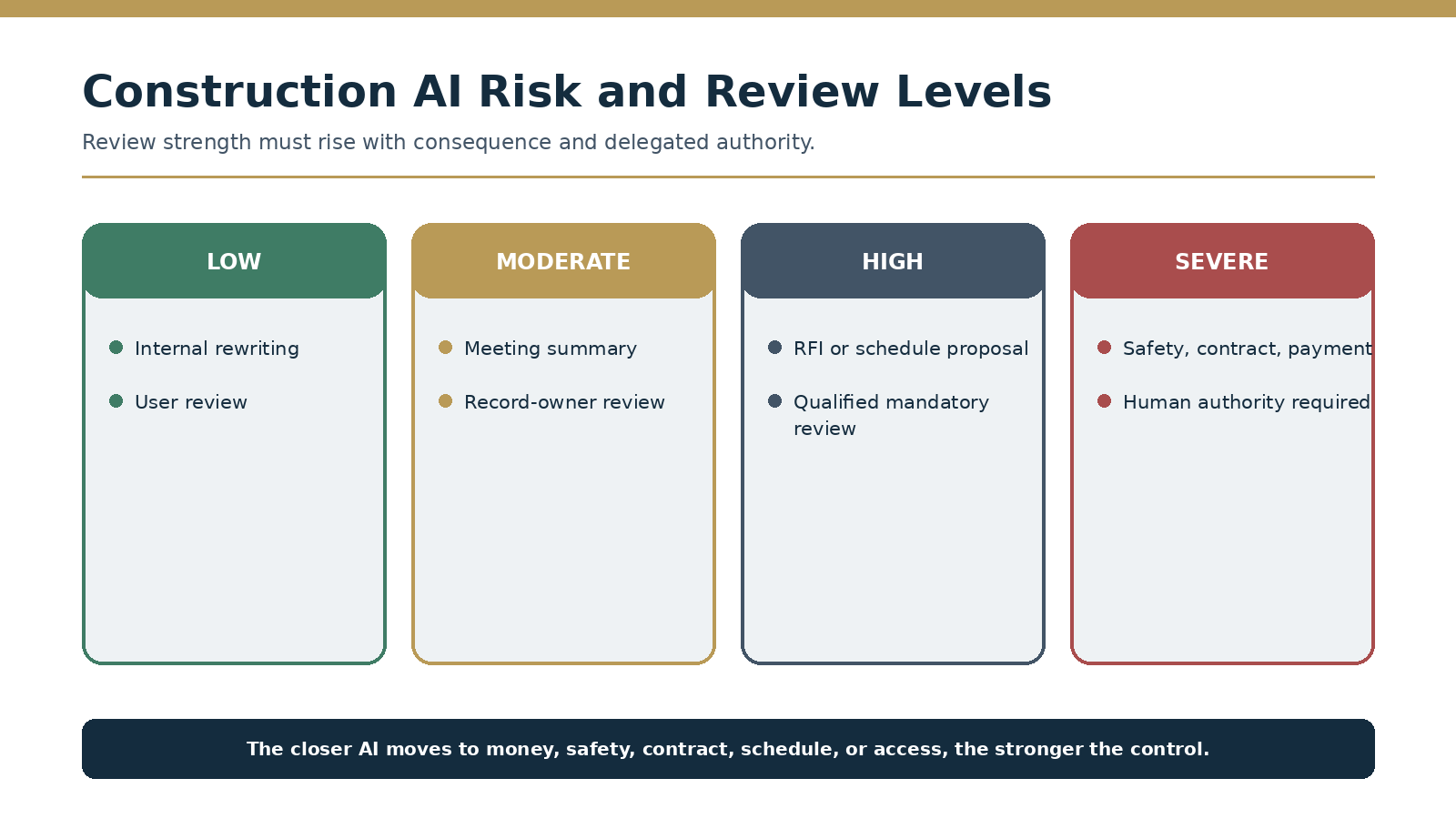
Low-consequence internal rewriting may require ordinary user review. RFI drafts require project-management review. Safety recommendations require qualified safety review. Schedule changes require scheduler or PM authority. Contract changes and payment releases require accountable human authorization.
The closer the system moves to money, schedule, safety, contract or access, the stronger and more explicit the control must become.
Syntecton’s role
Syntecton can make governance part of the workflow rather than a policy document sitting outside the software. Permissions, record status, responsibility, approval gates and audit history provide the operating controls AI needs.
The platform should continue to disclose the boundary between assistance and authority. That distinction builds more trust than exaggerated autonomy claims.