AI-First Construction Platforms vs AI-Added Software
Understand the difference between AI features added to fragmented construction software and AI operating within connected project data and workflows.
Most construction platforms will soon claim to be AI-powered. The relevant distinction is not whether AI appears in the interface. It is whether the underlying system was designed so intelligence can work safely across project operations.
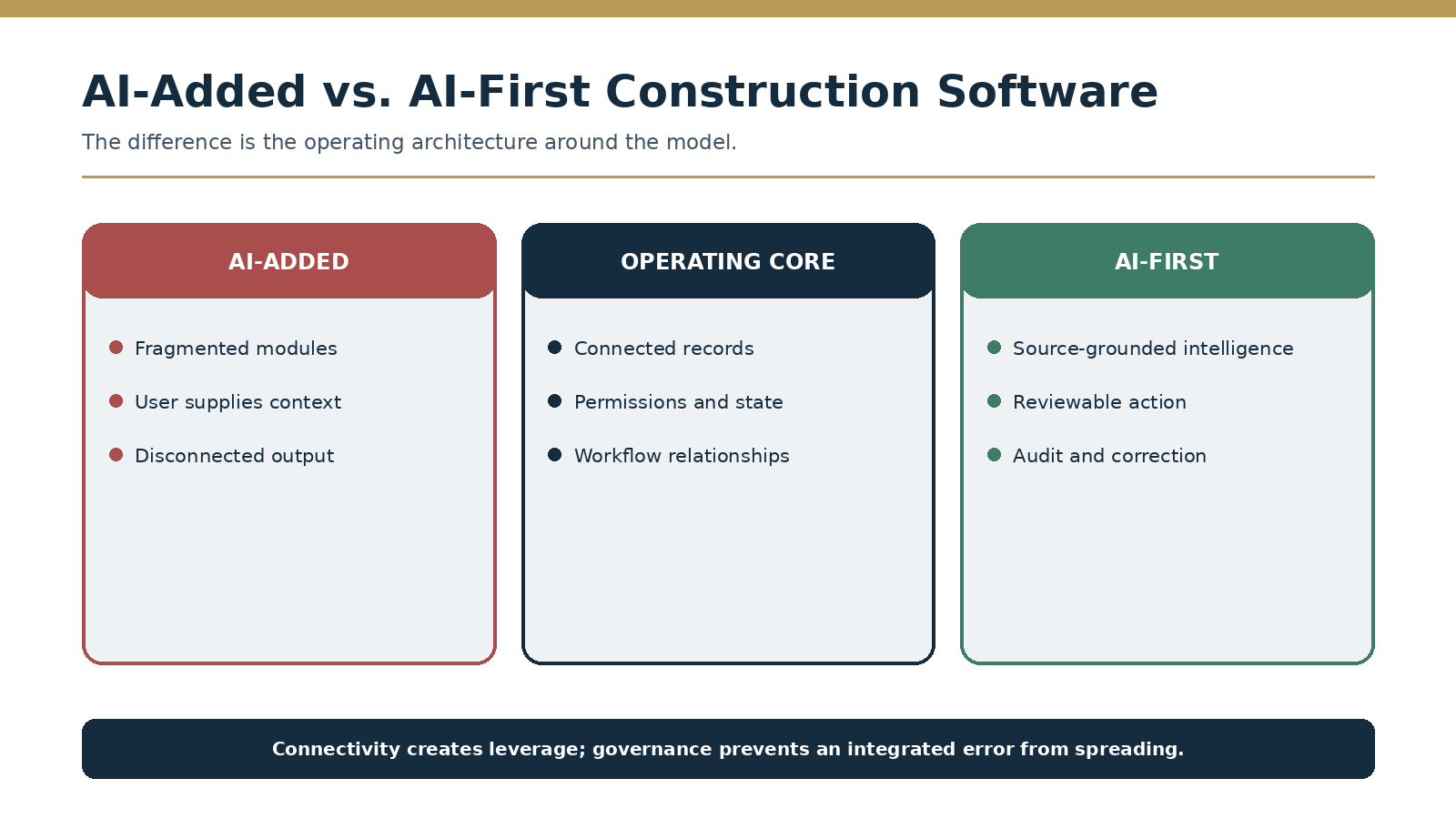
AI added to fragmented software can produce useful local conveniences. It cannot reliably coordinate what the architecture does not connect.
The AI-added pattern
An AI-added product commonly has these characteristics:
- a standalone assistant;
- context manually supplied by the user;
- answers limited to one module or document;
- output copied into another workflow;
- inconsistent permission behavior;
- weak understanding of record relationships; and
- no bounded action model.
This approach may still produce value for drafting and summarization. The problem is claiming that feature-level assistance constitutes project intelligence.
The AI-first operating pattern
An AI-first construction platform should provide:
- connected project records;
- stable identities and relationships;
- current-state and revision control;
- permission-aware retrieval;
- source-grounded answers;
- outputs created inside the relevant workflow;
- explicit approval authority;
- action and decision history; and
- measurable correction and failure handling.
“AI-first” should be judged by architecture and controls, not marketing language.
Why the data model matters
Suppose a field condition may affect cost and schedule. A document-centric assistant can summarize the RFI. An operating system can potentially connect the issue to:
- the controlling drawing and specification;
- responsible companies and reviewers;
- schedule activities and procurement dates;
- subcontract and prime-contract terms;
- proposed and approved changes;
- budget, commitments and forecast;
- daily reports and photographs; and
- meetings and commitments.
The intelligence lies in the relationships, not merely in the text.
Why workflow state matters
Construction information is not static. A proposed change is not an approved change. A draft RFI is not an issued RFI. An uploaded drawing is not necessarily the current published drawing.
An AI system must understand state before it can give reliable operational guidance. Otherwise it may blend possibilities, history and current authority into one answer.
Why permission architecture matters
Project collaboration involves parties with different rights. An owner, general contractor, architect and subcontractor may see different parts of the same issue.
An AI-first platform must apply those rights consistently to search, summaries, generated records and actions. It cannot treat the assistant as a privileged back door.
Why operating systems create leverage
When data and workflows are connected, one improvement can influence multiple operations. A structured RFI response can update the record, inform a commitment, surface schedule exposure, support change evaluation and appear in executive reporting.
That is different from buying another AI application and creating another information silo.
The tradeoff
AI-first architecture does not guarantee useful AI. It requires disciplined implementation, high-quality data, testing and restraint. An integrated system can also spread an error farther if authority and review are weak.
Buyers should therefore demand both connectivity and control.
Syntecton as a construction operating system
Syntecton’s strongest strategic claim is that construction intelligence should operate within the system that manages the work. Financial management, project controls, field execution and the project record should contribute to a governed view of project state.
This fills a gap between legacy suites that can be complex and costly, point solutions that address one workflow, and AI assistants that lack operational context.
The message must remain precise: connected architecture creates the foundation for more capable AI. It does not make every future capability available today.
The buying test
Ask a vendor to demonstrate one issue from detection through resolution:
- Which records did the AI retrieve?
- Were permissions applied first?
- Did it distinguish current authority?
- Did it show sources?
- Where did the output enter the workflow?
- Who approved the consequential action?
- What was logged?
- Can the result be corrected or reversed?
If the demonstration ends with generated text, the product may be AI-enabled. It has not demonstrated an AI-first operating system.